I hear it over and over in my head, day in and day out: standing in a rowdy line for tacos, sitting behind miles of Yosemite traffic, baking below the California sun at work, holding my phone high hoping for even one service bar, trying to fall asleep inside my tent while the neighbors' metal blasts through thin canvas walls. I hear the low, strong voice of an old woman climbing slowly into the back of a roasting hot bush taxi. "Kala suuru!" she barks at the muscular young men demanding she hurry up, adjusting piles of faded fabric draped around skeletal shoulders. "Kala suuru," she states again, easing with a sigh into a minute crevice between people on the jagged bench seat. We roar off, dust billowing in our wake.
"Kala suuru, kala suuru, kala suuru," I chant internally, chewing the tip of my tongue as I feign interest in the complaints of my peers and park guests, most often about "poor food choices" or "the heat."
But a nasty, bitter anger rolls in my stomach before I can stop it. No matter how much I hear it, how much I try to remember, the fact is that my patience wears thin these days.
They say that reverse culture shock is harder, and so I expected to struggle. What I didn't anticipate, probably foolishly, was how lonely it would feel to be back on American soil. I'm so much closer to my support system, to my family, after all.
Now, it is increasingly apparent that I am becoming readjusted to the States. Last week, I successfully grocery shopped without becoming irrationally angry at the peanut butter aisle, for example. But my longing for Niger, the friends I made there, the experiences I simply should be having, never leave my mind. Day in and day out I fight for patience, primarily with myself, and day after day, I fail. I wish I could say that I am better, but I must admit in the interest of honesty that I am still no where near the person I thought I was, and that it brings me to tears with embarrassing regularity. Finding patience in America is a different battle all together than in Niger.
Then again, everything is different all together than in Niger.
In Africa and Europe, which is to say in the past year, I had come to accept patience as something akin to faith. That is, patience at its core requires a person to operate in trust that the future will be different while she is still unable to see how it might be so. Perhaps it is the pace of life here, or because our needs are so fulfilled that our reasons for dissatisfaction are less tangible, but my foreign definition unravels as I attempt to wrap it around this new life.
Most often, my patience falters in my interaction with Americans. While my list of complaints about the culture that spawned me are seemingly endless, the root of my problem can be described in just one terrible word: apathy.
Several weeks ago after a long day of hiking, a couple of friends and I had come together for a pizza dinner. Conversation bounced around in areas of shared interest and knowledge until we came across a subject about which I knew nothing; the two began speaking about a celebrity of one sort or another, who had a book and a television show that I have never seen. Apparently appalled by my ignorance, these friends balked. "You've never heard of [insert name here]!" one barked in a volume that my affronted pride interpreted as shouting. The other jumped in next, equally disgusted that I should be so lame. They both laughed, and I was left feeling tiny and embarrassed. I can only assume this was their, perhaps unrecognized, intention. How dare I be so ignorant! Surely something must be wrong with me to not know [again, insert the name I can no longer recall].
I read an article once in TIME titled "Why We Care" with a large photo of Tiger Woods after his marital scandal stole the news. The author opined that our collective addiction to this celebrity culture was a symptom of the segmentation of our society. Naturally, we crave a subject we might discuss with anyone, a shared knowledge base in our increasingly niche-obsessed culture. We talk about these things because it is easy to do so, because we can assume that most everyone has seen "The Hangover," for example, or that even the woman in front of me in line for tacos will have formed an expressible opinion about Britney Spears or Amy Winehouse. Sure, with our close friends we might delve into deeper conversational waters, but amongst acquaintances and strangers, when grasping for subjects to fill the Fearsome Silence, we land in the shallow, albeit dramatic, lives and works of celebrities. Here, we can share our thoughts free from most worry of offending our company since most of us have little actual investment in these matters.
It seemed a logical argument, and so I've remembered it, but it provided little comfort that evening. As I nursed my bruised ego, I wondered to myself about the endless subjects about which my company knew little, and I couldn't help but to feel a bit arrogantly comforted by my travels and the breadth of my recent experiences. I'm not proud of the reaction, but it nevertheless allowed me to rejoin the conversation with less hesitation.
The same friends who seemed to regard me as small and ignorant that day are just as quick to cut off most statements I make about Africa. No one will be able to relate, I habitually remind myself, kala suuru, and I return to my lonely musings. But the matter stretches far beyond disinterest in the unrelateable, and I'm becoming exhausted with simplifying it thus. It is a matter of apathy. When it comes down to it, most of us care very little about poverty or desertification or malnutrition or illiteracy, blessed as we are to be unbothered by them. Even the exceptionally poor in our country enjoy amenities such as electricity and clean drinking water. While I can "kala suuru" the crap out of long lines and crowded buses and the broken community clothing dryers, I am simply not yet able to have patience with such apathy or the blatant, deep, dangerous ignorance it forgives.
Particularly not when I am made to feel embarrassed for my lack of knowledge in other, less prevalent subjects.
This is not an affliction of the developed world. While in Europe, and certainly while living in Ireland, I rarely needed to include my rehearsed explanation that Niger is "a country in West Africa north of Nigeria" in discussion. Common also was the knowledge that Niger is incredibly poor and suffers annual food shortages. These are things reported by the BBC, after all. Perhaps the geographical education systems in these countries surpass our own. However, it seemed more effective that a belittling similar to what I endured for my unfamiliarity with [aforementioned celebrity] might be applied upon different sorts of ignorance abroad. With so much more international interaction, and thus increased understanding that a world is swirling outside their borders, there exists a sense of responsibility to be informed about said world.
And you will be shamed if you are not.
What's the difference?
In Niger men drink tea. Around the village during the day, I'd come across small collections of men in shade, sitting around a metal basket of glowing charcoal with a tiny green or blue teapot balanced atop. The men came together and spoke, even if their discussions seemed sparse or of little consequence. In Ireland similar groups formed but around pints at the pub. We'd share stories of the day and of the island and mostly just babble nonsense, but we came because, people, we need each other! This social need, the desperation we feel to be part of something, to be recognized and thus valued by individuals outside of our immediate lives, spans continents, and so I've gathered it is part of our nature. But in the States we seem to have lost connection to such social endeavors. In our massive, segmented society, we interact with coworkers, friends and family in safe, private ways, but we often don't have an equivalent setting in which to be with people we don't well know, but yet somehow know.
I've been a regular at coffee shops since I was sixteen. With my best friend in high school, who has now settled in L.A., I'd drive to Louisville on Saturday afternoons to order absurd coffee concoctions and watch the people walk past. We tried many of Louisville's extensive coffee shop locales, but ultimately settled into just one, where it came to be that I no longer needed to specify my regular order. In college, I was often teased for the reliability that I was at the MT Cup after and between classes. There's something so wonderful about being recognized by the other regulars, these people who have no ultimate impact on my life, I guess. To be honest, I'd never much thought of it. But maybe this is what I was seeking: a place where people knew my name, or at least my face. As I've wandered this past year without such a place, I've felt distinctly more lost. We regard privacy so highly here, expect it to such a degree, that we've grown comfortable being anonymous in generic locations. We'd rather people just leave us alone and are bothered when they don't.
We aren't comfortable around each other, and we've forgotten how to listen. We can be apathetic to the plights of individuals beyond our immediate circle because, well, they're easy to ignore. Change the channel or flip the page, click a different link, and you can assure yourself that the life you know is the only one there is. Most people would rather not listen to stories to which they cannot relate or to which they might not know how to react, and well, as my grandma would say, you don't learn much with your mouth open.
Living sans a sense of our place in the larger community, much less the world, allows us to be apathetic. And we're allowing each other, and ourselves, to be ignorant.
A stranger asserted to me last week over my morning coffee that people don't read anymore. "That's why the country is in the state it's in," he declared. "We're not paying attention."
Well, no, we're not. It's impossible to care about the whole world, and it's painful to watch everything that's falling apart. We worry about those things which immediately affect us, and if we manage to manage those things, we feel damn good about it. As we should; we're all not just carrying heavy loads, we're juggling them. We're multitasking our lives away, forgetting how to relax, and never considering the necessity of patience.
So even if we do sit down in the company of people from whom we might learn, we're texting more people, checking our email, listening to music and in general running each other over. Even when we have a chance to listen, it no longer feels like we have a chance to listen. Just a second, let me check my facebook....
It overwhelms me, this pace of things, and I can't remember the last time I sat down for tea. Perhaps Yosemite living is more so this way, desperate as we are in every moment of precious sunlight to be doing all the wonderful things at our disposal that we feel guilty for sitting. But what a shame, surrounded by such majesty, that we should feel obligated to ensure our personal lives are competing. We grow so concerned with our ability to climb the hardest routes, trek the longest trails, prove ourselves the fittest and fastest, that we forget even amongst the mountains and raging waterfalls and towering trees that we are tiny and humble. Ultimately, we are at the disposal of the natural world and not the other way around. If we had control, what need would we have for all this patience?
William Berry didn't call it patience, but he nonetheless knew what I mean: "We spend great energy in mental processes wishing things were different than they are. Wishing the traffic jam didn’t exist. Wishing the boss were a little nicer, wishing our children would take our advice, wishing, wishing, wishing. Acceptance is a key to a happier life. If we can just try to accept what is, and that wanting otherwise is often wasted energy, we will be happier. We would be better able to experience the moment more fully with this state of mind."
Saturday, July 30, 2011
apples in the summer are golden sweet

Wednesday, June 15, 2011
well how I curse that western skyline
I left Louisville in the burning heat. The first week of July in Southern Indiana traditionally welcomes a sticky, heavy summer air. Your feet beg to be released from shoes and a halo of hair sticks determinately to the rim of your forehead. So I climbed on a plane.
After a couple of days in Philadelphia we flew to Niger, where I met a sort of hot I'd never known. It was sweltering, blistering and drier than I thought possible. My lips chapped, my skin roasted, and in the heat of the day I laid prostrate in my hut with my skirt hiked up, sweating buckets and trying not to die.
A headache in this sort of weather taught me a new lesson in...patience.
But after weeks in this environment, my body blessedly adjusted. (It's incredible what we can endure.) When rainy season ended, taking with it its nightly relief, we were tossed unprepared into a mini hot season. Somehow, the air became even drier, tossing sand, trash and very small rocks into the air to cruelly pelt the skin. To look at the calendar, though, it still made sense for it to be hot. Perhaps this was a new level, but the concept of late summer heat was neither new nor unatural.
Then came October, and the summer roared on.
After I moved to Kollo, the air morphed again into what we were calling "Cold Season." It sounded absurd, I'm sure, to those few precious people who I talked to during this time, that I was shivering in 80 degree weather, but we donned hoodies and leggings to battle the new "cold" air. Many even moved indoors for the chilly nights, and I was told often by my villagers that I should follow suit to guard against an oncoming cold.
Sure enough, I was soon coughing and sneezing with my annual sinus infection.
November was fall; breezes in the village tossed black plastic bags into the air like fallen leaves. I huddled down, guzzingling instant coffee and hot chocolate I'd received in a package, trying to stay warm as temperatures dipped into the 60s at night.
But before I knew it, the calendar declared it was December, then January, and it was still an autumn I would've once called summer. The stranger the weather, the farther Niger felt from home; cool air thrust into me a homesickness for which I hadn't yet discovered a cure. I returned to Hamdallaye for In-Service Training (IST) grateful not only for the break from Village Life, but also for the long-awaited companionship of my fellow Americans, certain they'd re-ground my mind, which was spinning as rapidly as the whirlling winds of Cold Season.
Then we received the evacutation notice.
When we landed in Morocco two days later, Peace Corps allowed us a small amount of money to buy warmer clothes, aware at very least that we were completely unprepared for any sort of actual cold. We shivered and complained, and the weather made the whole ordeal seem all the more surreal.
Of course as you've read, from there I travelled through Europe in the gripse of legitimate winter. We purchased gloves, hats, coats and turtlenecks from the African market, but we were still no where close to ready for such low temperatures.
Or for those sweeping grey skies.
For the months of January and February, I was in snowless winter, biting winds whipped cruelly around aged cathedrals and along frigid canals. Hostels were seriously cold, often lacking central heat, and my Africa-accustommed body continued to shiver late into every morning. The pace of the adventure kept me warm enough, however, and while I vivdly remember being cold, it never felt like a winter I had known.
We huddled around space heaters and tucked ourselves under thick blankets.
In Prague I saw snow for the first time but only to fly to Ireland the same day and be greeted by the traditional endless rain. But for all the times I called it winter, Ireland insisted it was spring. At the turn of March, the daffodils were already in full bloom, sweeping spectacularly across countrysides already a richer green than even the Midwest boasts. Spring blooms spilled from windowboxes, and I busied myself planting seeds and infant flowers on the Cape.
Even as I was leaving six weeks later, it was surely spring, temperatures dipping low in the night only to rise again in the longer sun. I spent my last day in the country tossing a frisbee at St. Stephen's Green with another travelling American, only to shiver my way home despite his leather jacket and a Stout Irish Beer Coat.
So I flew to Alabama. In the South, spring was a whole different beast. Azaela bushes screamed from the front of every home and Crepe Murtles bore blooms the like of which we can't imagine up north. But these are early bloomers, and even though the warmth invited sandalled feet, I couldn't be fooled into believing it was summer. Storms blew in, as you likely heard, and I hudled one afternoon alone in my brother's apartment bathroom praying passionately for a quick and quiet end to spring's tornado season.
When I arrived back along the Ohio, where I spent a slow three weeks, I finally began detecting summer around the corner. I could wear t-shirts again for the first time since Niger, and the air didn't bite so sharply in the evenings. In fact, just before I left again, I spotted my first lightning bug, a sure sign of early summer.
But mostly, it was still spring. And so I flew to California.
Now, they say it doesn't rain here, but they lie. In fact, yesterday I meandered home from Yosemite Village to my tent near Curry Village, past massive trees, dumping waterfalls and towering cliffs, traversing the quick, ice-cold, crystal-clear river, in a mean, pelting sleet. By the time I arrived home, the sun was back to shining. Yosemite survived a hellish winter; the high camps are likely to be closed until mid-July at best because of extraordinary snow. Now in June, the Valley is gushing with water from every angle, and conversations rarely forget to include flood predictions, but the dogwoods and the redbuds remind me everyday that I'm still in the heart of spring, for my fifth consecutive month.
"Adopt the pace of nature;" Emerson wrote, "her secret is patience," but maybe he never knew a year like the one I just lived. I wish more than anything to find this Truth in myself somewhere, but despite myself, I'm looking forward to heat more than ever. I miss the baking Nigerien sun, and the way your cheeks get tight as sweat dries. I want warm nights and long, hot hikes through the backcountry. I want to get to know the Yosemite summer.
We're lucky at home to enjoy all four seasons, and I've relied on them for a lifetime to tell me that time is passing. Perhaps this is why I forget sometimes that a year has passed since I tossed that pack on my back for the first time in my parent's driveway, bound unimaginably for Africa.
But it did, even if it didn't turn out as I could have expected.
It seems reasonable some days to say it was just a year, just one twenty-third of my tale, just one or two chapters, maybe. But it wasn't just a year. Still stuck in this endless spring, it occurs to me that even when the heat hits as it surely will, life won't come full circle as perhaps I've allowed myself to imagine.
Perhaps in reality I will never be the same.
Monday, May 23, 2011
Vol. 4: a ticket home
I've neglected this blog for the last couple of months, so a special thanks to anyone still reading it. I had my traditional wordy, rambling post written, carrying us from the morning I awoke on my own in Prague to the day I landed in the Birmingham airport at one in the morning, exhausted and without luggage, but unfortunately my Macbook's hard drive recently went ka-put, taking my precious InDesign, blog post and a library of music I'd joyously downloaded with it to the grave. Kala suuru.
So I am offering only the abridged version of the story here, partly because my rewrites always turn out sloppy and also because I've been recently blessed with the opportunity to share much of this story with family and friends in person.
Because in case you didn't hear, I am finally back in the States.
However, I am no longer in Louisville. We'll get to that in a moment. For now lets rewind back to the Czech-Inn, one of my favorite hostels in Europe, where I woke groggy and hungover to the sight of a strip a clean, bright sun filtering in through the thick curtains onto the dorm floor. I laid under my thick, Moroccan blanket for a few moments staring blindly at the spot before it registered: where Nichole's pack should have been was just a runway of empty light. According to my journal, I rolled back over, sighed and fell back into a protesting sleep.
When I finally convinced myself to go down for a coffee, I was more awake but no more enthused about my new reality; I was alone.
I stepped into the bright lobby, steaming mug in hand, and stopped dead: it snowed. I know no one will pity me when I say that it was the first (previously only) snow I'd seen that winter and it was only a quarter inch, but it changed everything.
Now, I know it wasn't actually the snow. I already had a new adventure booked, tickets to Ireland tucked into my planner, and still without a set date to return to America, my European bubble was existing firmly, wildly without an expiration date. But I'd gone to bed in one reality and woken to an entirely new one again.
For heaven's sake, how many times can that happen in a year?
Now separate from my travel mates, I was leaving the world in which Things Made Sense and entering a uniquely misunderstood existence. By now you've realized I have a tendency to be melodramatic, but in this case there is some reason to be. Since that morning, I haven't had a single two-way conversation about Niger. I can talk and talk and talk, I can write and write and write, but I can make no better sense of it. Anymore, it doesn't sound real to me, and I lived it. To those who have had no contact with that world, explanations fall abysmally short. The thoughts that cross my mind on a daily basis, those about Niger, about Djamila, about my loved ones there and the precious times we had, I must hold privately. They can't possibly register the way I need them to; I am alone. So, as I crunched my way through the streets of Prague to the airport that morning, nothing else mattered; I was alone.
The melancholy of it all did not wear away for the several days it took to travel to Dublin, then Cork and finally to Baltimore, where I caught my ferry to Cape Clear Island. To be even more honest, even now I'm not certain the blue has fully receded from my post-Peace Corps existence. But we're getting there.
I arrived in Ireland with only a vague idea of where I was going, and it was a testament to how far I'd come in the past year that I was unperturbed by the lack of details. I made it to the island, where I hoped someone would pick me up on the pier. And I could grasp only to the belief that things would fall into place.
Which of course they did. I spent the following six weeks on the Cape, doing odd jobs around the grounds of the pubs and guest accommodations where I lived with a Kiwi and the friend-of-a-friend I'd met briefly in Germany. We took instructions from a chain-smoking South African woman. In the evenings we'd tromp through the bouncy, emerald grass to the cliffs where we'd watch birds sail and dive as the sun went down. We climbed into the ruins of an old castle one afternoon, and we saw the standing stones, the cemetery, the inland lake. We spent St. Patrick's Day in Cork. Every Thursday I took an evening pottery class in North Harbor. Nights were in the pubs, either pulling pints or drinking them, where over time I finally adjusted to the melody and variance of the Irish accent. But every foggy morning, my ability to understand faded again. At one point, I turned 23. And we listened to the stories, and we listened to the songs, and it was just about as poetic as it sounds. And yes, there were loads of spuds.
But before I knew it I was bidding goodbye to this new home too, and to a tall, ginger Irishman. I spent two nights in a hostel in Dublin before that crazy flight back to the States. I was bound for Birmingham to spend some time in my brother's new home. Unfortunately, it was the hardest travel day of my life, but that's a story worthy of a lively telling the next time we meet. After about 26 hours, I was seated in the humid Southern air again, waiting desperately for the sight of my tall, bearded brother, the first of my loved ones to be within hugging distance for roughly ten months.
But not just any ten months.
After Birmingham, I travelled to St. Louis to meet my dad, who was working there. And I had a whole new chance to try, try, try to tell my stories again. After a couple of days, we drove back home, where we found my mom digging in her flower gardens. And I tried again. The next week I went back to Muncie to see my old friends, another new audience for all these crazy things I have to say. But mostly we all laughed and hugged and celebrated, and I discovered that the few people who had kept in touch with me during my time away really were the best of the people that I knew.
But it took only about three weeks for stagnation to drive me crazy, and so last Tuesday I climbed onto another plane, headed even further West.
I'm living in Yosemite National Park for the summer, where a couple of people I love and trust have said I might find peace. And if that isn't the goal of all this wandering, I'm not sure what is.
Tuesday, April 5, 2011
Vol. 3: a cone of french fries, please
After a photo of the girls passed out on the floor of the Madrid airport, there is a gap of about eight hours from my camera. Scrolling through my albums, we can be seen bouncing about in the sunshine of Spain, dancing late into the night in comically oversized shades, frolicking at the airport and then BAM! Amsterdam. It's a startingly accurate perspective on the day.
I hate flying. As terrible as long bus rides leave me feeling, as frustrating as trains can be, as expensive as taxis and as turbulent as ferries, I detest nothing more strongly than airplanes. After crawling on board, we promptly passed back out for the short hop over France, those two hours serving as our "night's sleep." When we landed, not a one of us moved until every other person had exitted, then we drug ourselves into Amsterdam under the grey pall of sour hangovers. We caught a train, then a tram and finally walked our packs to our first Amsterdam homestay: a hotel basement. Soon after, we met up with a friend of Cassie's who is living in France and together slouched into a restaurant for some sort of lunch deal. If my mouth openned during this time frame, the words undoubtedly did not form sentences. I was in a daze, as travel sometimes causes, and it robbed me of the excitement I had expected upon arriving to our destination; instead, the city and the people were warped and surreal. I can remember only a few times in my life that I have been so simultaneously exhausted, starving and dehydrated.
Sometime late that afternoon, however, the photos start flowing again. In those first pictures, we're seated around a low wooden table shaped like a massive guitar, dotted with six cups of steaming coffee, our faces plastered with wide, excited grins; their expressions relaying the ellation I had anticipated since leaving Morocco. We were finally in Amsterdam.
Because it was our last planned stop on the trip, and because none of us yet had any solid plans for after, we scheduled ourselves a full week in the city. With so much time, we finally had a chance to get a deeper impression of a place and, for the others at least, to figure out the city's layout. (My own sense of direction is rather hopeless, I'm afriad.) The Amsterdam we discovered, that folded us into its comfortable grooves, was far beyond what I can articulate here, but suffice it to say that it was equally far from what you might expect of it.
And that, I think, makes it all the more charming.
Not that Amsterdam needs much help in that department. It isn't possible to describe all the delights hidden amongst that city, but from the far reaching canal system to the twisted, bended building faces, to the cascading stacks of bicycles leaned and chained to every upstanding structure, you'd have to be heartless not to fall in love with it.
Near the Dam, I suppose it would be easy to get lost in the sea of tourists and their traps, to be blinded by the lights of chain restaurants and generic bars slinging overpriced drinks, but just beyond these places and hidden in the alleys between is a city overflowing with residents who love it, and there's nothing more beautiful in a city than happy people. Even on the cold, cloudy days we spent there, the city was alive.
But Amsterdam seems to live in a comfortable manner, like its been worn throughout the long years and has grown wise, as if it is enjoying old age. The corners of every surface have been airbrushed with bright moss, and as written in my ol' notebook, "the buildings have all settled in for a little tea and perhaps convesation;" their tall peaked roofs literally bend over to greet you.
Dotted within the heavy architecture set arm-in-arm along the narrow cobblestone streets, whipped cruelly by the wind, are the clean, beautiful lines of modern typography; together presenting the city's philosphy of protection and progression (e.g. Bibliotheek, the Amsterdam Library). "Everything seems to be done in a lovely way on purpose," I wrote, although I realize now the sentiment sprouted from the months I'd spent in Africa, where literally everything exists in varying degrees of disrepair.
In fact, while there, we'd all grown to accept that things don't have to make sense. They almost always did not, you see, and you could hunt for reason, but it was so often in vain that you'd eventually stop trying. Accepting things at face value, we'd lived in a world that just should not exist as it does. And we'd been happy. Now in a place of such grandeur, I was remembering that once upon a time I'd believed in causes, inspirations, and that I'd often wondered why.
But what is better? Straightforward acceptance of the present surely allows for more peace as life tosses dripping, manky garbage at you. It is this that allows us to have patience and trust. Contemplation of cause quickly leads to blame.
But we cannot live without wondering "why" because we cannot grow without these considerations. 'Tis the rub, isn't it? We much cherish our curiosity and master simplicity, or cherish simplicity and master our curiosity, but without devotion to both, we're doomed to become exaggerated versions of people we don't want to be.
People bound for discontent.
Whatever we were bound for as we began our adventure in Amsterdam, it was certainly not discontent. After the misadventure of our first day, which ended gloriously early, we woke ready for Amsterdam to show us her stuff, so to say. When she laid out before us, we were enraptured. As the week flew past, our conversations were becoming more and more dominated by future-speak, but a new dream had formed: fuck it, lets just stay here. That pipedream distracted us on many on occassion, particularly when the real discussion of splitting up and heading home became a bit overwhelming.
Generously, Amsterdam offered a variety of additional diversions. As I wrote previously, travelling with others who could relate to my reintroduction to the non-Niger world was clutch in my attempt to stay sane during this time. As a small example, on Saturday we made it to the library mentioned above, and had a beautiful lunch at the cafe on the top floor. At another point, we wandered into a fantastic bookstore (which I spent the rest of our time searching for but could not find it again). Books! Books that people read! Books in English, even, that people read! I was basking in the written word in Amsterdam and in every sign of others' appreciation of it. In the bookstore I found a new copy of the New Yorker, and nearly paid the 12 euro for it just for the singular joy of openning my first timely copy after months of reading the discarded '90s and '00s editions discarded by volunteers long since gone from Niger.
The next day we gathered our packs again to move to a hostel further outside of town. We hopped a tram and were dropped on a deserted street corner, so a couple of us popped into a nearby grocery store to ask directions. (Gloriously, and for the first time in months, we could speak English and know we'd be understood; the Dutch speak perfect English.) Inside we met Michael, a friendly man browsing for produce, who didn't know where we were headed. Determined to help, he called his wife, who googled directions and called him back for us. Impressed by his assistance, we were unsurprised to learn that he was African. Originally from Cameroon, Michael not only supplied us with perfect directions to our hostel, but he emailed us after expressing his gladness to have met us and offering his phone number should we need anything else during our stay in Amsterdam. African hospitality is deep and genuine, and we were grateful for the brief taste of home.
Our new hostel would house us until Friday, when our trip would splinter. By this point, I'd booked a flight from Prague to Dublin for the following Saturday. My mission was going to be to make it to Prague, where I'd meet back up with two of my travelling mates who were taking different routes through Germany.
Wait, wait, wait, we still have six days in Amsterdam!
We were staying in an old school building converted into a massive, shiny hostel, which was pretty much as scary as it sounds, and they were charging for internet. Since we were all attempting to plan seperate trips (and futures), this meant the ongoing mission for the week was to locate coffeeshops that offered internet. This is not as easy a task as it seems; internet access in Europe is miserable compared to the sweeping, expected coverage in the States. We all had different things we wanted or needed to get done, so we took to setting family meeting times in various places around town. This allowed us to toodle in our own, beautifully unique ways. In other words, it allowed the more ambitious among us to be free from those more content to sit on her bum in ill-lit corners, consume coffee and write, write, write. Or to work half-assedly at improving her chess game.
My satisfaction with such pastimes caused me to miss the Anne Frank House, but I will surely visit on my next stay in the city. The impression I received from everyone else was lackluster anyway. Instead, I spent the euro perusing the Van Gogh museum, from which I can recall unforutunately little other than a few familiar paintings and lunch at the trendy cafe.
And on Monday, we all went to the zoo.
The Amsterdam Zoo was easily my favorite part of the week. It was a telling episode from the full EuroCrash series as nearly everyone was able to spend the time doing exatraordinary versions of what they were inclined to do anyway and within the confines of a lovely city zoo. The only exception to this is that I didn't lose anything while at the zoo, which I believe was the only five hour span in which this was the case. As if to make up for it, I managed to get horribly lost despite having purchased the map, but that wasn't altogether unpleasant as I was greeted at the end with the sight of Sam bursting from the Aquarium doors, on what was at least her third trip though, a bright blue scarf wrapped around her laughing face. That girl's joy is infectious.
Our five journeys through the zoo weaved in and out of one anothers' like this throughout the day, generating a feeling that the zoo belonged to us. It was a hazy late-winter day, and the sun flowed through the trees and exotic plants with a grace I'll forever associate with Europe. The zoo seemed to be holding secrets: tiny statues of monkeys in quirky postures tucked into corners and gardens camoflauged behind animal cages. In itself, the Amsterdam Zoo is really nice, but with us there, it was spectacular. The animals seemed happy to see us as well, or at least willing to perform for us. It was one of those days you'll forever talk about without ever managing to communicate even close to the greatness of living it.
As the week wound down, I found myself all the more content to sit, enjoying the feeling of having a plan with so many gaping unknowns, but found doing so alone made me feel a bit like a creep. At the Barraka Coffeeshop, deep into my notebook entry the handwriting grows less legibile. I had finally found words for one of my lingering worries: "It's hard to imagine attempting to interact with the people who knew me last year," I mused. "I'm just not the same. What's worse, though, or complicating, is that I have no desire to return to being that person; I'm actually afraid to go back to all that..." While fear of the unknown is natural, this new fear of the known, of the comfortable that I'd pined for in my most homesick African hours, is much more difficult to explain.
The battle to hold onto Djamila in Julia's world has proven complicated. "Once I'm on my own I think I'll stay Djamila much more naturally than I would've without this trip to Amsterdam," I wrote. Djamila, I reasoned, was most often by herself, so my lone travels through Germany were going to be her chance to show her face in my life after Niger. "I miss Djamila..." I'd later write on a train to Cologne, "and I can't help but feel cheated out of this part of myself I'd only started to get to know. Now I worry she'll recede, pull back now that we're in this other world, and that I might lose her forever. In so many ways, Djamila was better than Julia has ever managed. I will regress too with the loss of her. With my fellow Niger volunteers around, I could pull Djamila out, Zarma & Niger & PC always in our conversations & minds. But I know people won't want to hear about it at home, that I'll have to hold my tongue to keep from annoying people. Maybe I will begin to forget in my silence and isolation, until the whole experience is just a bullet point on my resume.
"It's an overwhelming sadness, different from the way I felt missing home. It's heavy, another weight in my pack, and it slows my steps and catches my breath when I'm out on the street. If I'm sitting still, it's just a bothersome pressure, but when I try to move, the sad holds me still."
Up until our last couple of days in Amsterdam, I hadn't allowed myself to be sad. I'd hardly managed to cry, instead holding onto anger to keep the tears at bay. Now facing the departure of the very last of my Peace Corps contacts, the blue was dripping in like rain.
Friday was the beginning of the end, but due to a painfully irresponsible streak, I spent the day running around town attempting to deal with a lost wallet. The three of us who were left had moved to a third homestay: a hostel closer to the train station that we'd wandered into a couple of days before and determined was perfect for us. I had plans Saturday morning to take a train to Cologne, a site I'd chosen for soccer, beer and an art museum, while the two others en route to Prague would head to Berlin and Hamburg. It would be my first experience travelling alone, and so I was ignorantly less excited than I should've been. I was much more focused on the "goodbye" parts of my day, my lost wallet and my last precious hours in the city.
As might've been predicted, I didn't take an early train out of Amsterdam. That morning, I walked to the station in the rain to see off Malika, who I'd expected to see again in Ireland, only to discover I was afterward locked out of the hostel. Since my card had gone with my wallet, I wasn't able to check my pack at the station as I'd planned, so not only was I soaking and stuck, I was hauling everything I owned. Also, my phone was dead. The lobby openned at 8 a.m. so until then, I ducked into a cafe and spent the last two euro I had to my name. It occurs to me now that had I been found in such a predicament last year, I would likely have panicked. Instead, I just waited.
Rather than hopping the train right away, I spent the day lingering in the company of my last Peace Corps friend, laughing, telling stories, eating waffles and drinking coffee. Could it have been only a month since he'd come across me on the Rabat rooftop spitting at cats?
Eventually I did head sadly out of Amsterdam on a German ICE train that cost a nauseating chunk of my euro and arrived in Cologne in the dark. I found my hostel near the university bars, settled into a room occupied by an Aussie and a Frenchie, and tucked myself into a corner of the hostel bar to enjoy the German beer I'd been craving. After a quick bite, I called it early, looking forward to the full day all to myself.
I caught up on a bit of the sleep I'd fully neglected in Amsterdam, showered and put in my contacts for the first time since Swear-In. I hid my few valuables, left my room and punched the elevator button. A British guy came out of a room near mine, and we greeted one another casually. "I'm Dylan," he said. Shit.
I grabbed a cheese and ham croissant for breakfast from a nearby cafe and splurged on a chai latte, a long forgotten guilty pleasure from my life Before. I poured over the German paper, flipping through until I found the crossword puzzle (which I could decipher none of and so settled instead on tackling the sudoku), and munched contentedly. Looking up I noticed a plaque hanging on the wall near a clock, which had long since given up its count. "HEAVEN IS RIGHT HERE."
I walked down to the Cathedral and along the river, eventually finding my way to the modern art museum. After a few hours, I followed some heavily costumed and highly intoxicated soccer fans into a bar for the match. In the streets, fans shouted and sang, and the roar from the pitch came in off the wind. Eventually the chilly air pushed me back to the hostel, where Dylan, which is likely spelled Dillon, had found another English-speaker, an Aussie named Adam, to join our hunt for some fun way to spend the evening. We passed a few hours in the kitchen with a gang of Spanish guys in Cologne on holiday, then went out to a club we'd snagged tickets to.
Needless to say, I did not make my morning train to Frankfurt the next day.
Next to my friends' travels to Berlin, my path through Germany seems a bit arbitrary. In fact, I was headed to Frankfurt to meet a friend of a friend who was studying German there, which pretty much sums up everything I knew about this guy before showing up on his doorstep, so to speak. Because I'd been foolish and missed my train, and because I was unwilling to pay for the arrogantly priced German high-speed train a second time, I didn't make it to Frankfurt in time to get to the Western Union. I also hadn't done laundry in nearly a week, and my Dutch sim card was inconveniently and inexplicably nonfunctional.
I was still dramatically hungover from the night before, and due to my severely limited funds two Snickers bars on the train had sufficed as my daily meal. Otherwise I'd purchased an espresso in exchange for the internet password and was thus dead broke, smelly and spastic. Hello! My name is Julia. Add to the scene: it was Valentine's Day.
By the time we met that night, I'd given up any hope of living up to whatever expectations this stranger might have of me, and instead sat patiently waiting, realizing a bit too late that I didn't have the slightest idea what he looked like. Eying each person who came through the door, I tried to imagine what my friend might look like after what was nearly a year since we'd last seen one another, and thus how a friend of his might be. Then a bearded guy in a I'm-not-even-kidding corduroy coat appeared. Of course.
So I spent a late evening in the company of one Sean Anderson in a very American pub near the Dom in Frankfurt. The next day we wandered through a beautiful old cemetary and ran into a couple of his German friends as we were drinking the type of good, cheap coffee only the locals seem to know about. We ate free samples at a brightly colored market and wandered to the top of a strange building overlooking the dull grey German skyline. He pointed me in the direction of my metro that evening and bid me farewell. "We'll see each other again," he said with a wink not unlike my friend's. "In Sha'allah," and I trotted down the subway steps.
I'm writing this blog in my usual spot in the dining room of the guest accomodations where I have been WWOOFing for nearly six weeks. Currently, Sean is in the kitchen, singing along to a tacky 80s ballad playing on our favorite Irish radio station as he cooks himself a sausie for lunch. It's our last couple of days on the Cape, and while I'm well ready to get home, I must thank Allah for the preciously unique people he's put in my path.
I took night transport to Prague, which managed to depart late and arrive early, and thus found myself disorientedly at a station in the Czech Republic in the dark again. And I needed to pee. I heaved on my pack and headed toward what I determined must be the toilets only to have my euro turned away at the door. The exchange booth wouldn't open for nearly an hour and I didn't have a single Czech koruna. Despite my obvious desperation, the evil keeper of the station bathroom refused to let me in. Welcome to Prague!
So I headed instead to the cafe and waited again. As soon as I could I flipped my money, took a glorious leak and bought a coffee and some juice, settling in until the sun rose to lead me to my hostel, where I was greeted by the smiling face of my old travelling buddy. We decided to meet for a late lunch, and headed off to explore this new beautiful, old city. After showering and wandering aimlessly for a few hours, I returned to the hostel to see my second friend grinning on the lobby couch.
Sometimes I wonder what I've done to deserve having seen so much in my young life. I am so lucky for the places I've visited, and the startling beauty of Prague overwhelmed me with gratefulness. And yet nothing I have seen or done comes close to how blessed I am to know the people who I know. On that first day in Prague these two familar faces, neither of whom I'd known a month before, were immaculate.
The next day was Nichole's birthday, and we spent a silly afternoon exploring the Prague Castle before enjoying a Mexican dinner and too much whiskey. After the long, long night at a 5-story club, I woke late on Friday, hauling my computer down to the hostel bar where I drank coffee and nursed my shame in my PJs until a vaguely appropriate hour to switch to beer. Eventually, the three of us were together again, and when we were finally convinced to leave the warmth of the hostel, we headed to the Strahov Monastic Brewery, a little gem founded in 1142.
We rode the tram up the hill and set to our first mission: beer and food. Roughly five hours later the mission hadn't changed, nor had we seen any other part of the monastery; it was one my favorite days of the entire trip.
Just as we were leaving, Nichole receieved a call from a friend (and former Niger volunteer) who had recently moved to Prague for a TEFL program. We met her and her friends at a really great downstairs bar, the name of which I unfortunately neglected to write down. "It used to be fun to make fun of Americans," her Canadian friend explained a few drinks in, "but it's not anymore. Now its a bit like kicking a kid when he's down." I sat in content apathy as the other three spoke Hausa, comfortable in this familiar type of indecipherable chatter. And it didn't really matter that I was a Zarma, or that I'd never visited Zinder, or that this new Jamila hadn't been in country at the same time as me. What mattered is that she knew Niger and so did we; it mattered only that we shared the specific kind of love you feel for a place like Niger.
When we finally returned to the hostel, Max and I headed back out for one last beer together at the trashy "non-stop" bar across the street. The run-down bartender had agreed to play Waka Waka for us, so we sat waiting and waiting, entertained by all the, um, characters around.
Finally, we heard it. "AHHHHHHHHH!" filled the room, and we looked at each other, eyes wide and excited.
But just as suddenly, it stopped. We looked around.
A cell phone.
Laughing, we left the bar and said our goodbyes. I would fly to Dublin the next day as the other two headed to Vienna. And in time we would each head back the States, to Kentucky or New York or Utah, and our paths would meet again some day, in sha'allah.
Or so we said.
My head hit the pillow that night with a soft pft, but if I hadn't known better, I'd say it was the sound of my PC Niger book closing.
Wednesday, March 30, 2011
Vol. 2: Como esta la casa de gato?
I wish I could say that we burst into Spain, but the truth is they had to prod us a bit to get us off the ferry. When we finally did stumble down the ramp to Algeciras, we found ourselves in another world completely; we'd entered the Christian world.
What does this mean to five young travellers fresh off the boat from life in a conservative Muslim land?
After settling into our hostel, a more difficult task than previously as all but one of us had returned to being deaf to the local language, and a bit of exploration, we landed at our first bar and ordered beer in public. "To Christianity!" we cheered, and approximately three beers later we were skipping through the quaint streets with stones all laid in charming patterns, laughing at ourselves and our rediscovered abandon. Trees in the parks hung heavy with oranges and an open-air market bore the biggest, brightest produce we'd seen yet. And we talked about Niger; and we told stories of our lives before; and we planned for Amsterdam; and we sang along to the campy pop songs that played on the radio. And we started, slowly slowly, to figure one another out.
As delightful as it sounds to travel with your close friends, I discovered on this trip that it can be far more enjoyable to get to know people via adventurous circumstances. As Peace Corps itself demonstrated, sometimes the relationships you build out of necessity, surrounded by unfamiliarity, as your knowledge of yourself is growing, can be the most fruitful. There is some chance, of course, that I happened to travel with four of the most interesting people I've known. But either way, the hours I spent at home squeezed onto the same couches as my close friends can't sustain me in the same way as a single eight hour bus ride through the mountains of Spain. Maybe it inspires a different type of interaction, maybe it builds rapid trust or maybe it's just a hell of a lot of fun, but that first day in Algeciras was the beginning of the rhythm we developed and, I think, we were all grateful for it at some point during the following weeks.
It sounds terrible, but I have to consult my planner to write my way through Spain. It doesn't seem like its been long enough to have forgotten so much, but with days so full, its difficult to recall it all. (Alhamdilalai.)
So, according to this, we spent just one (very early) night in Algeciras before climbing onto a bus to Grenada. Once again, we didn't have a hostel booked, so upon arrival we jumped a city bus toward the Cathedral. We were bobbing along, laden with our heavy bags, when our ears caught two things: First, the American accents of two make-up coated girls seated near us. Next to us, these girls looked clean, rich and, we resasoned, superficial. Study abroad students. Throughout our trip we'd run into more American study abroaders clogging museums and various attractions, and they nearly always proved lewd and alien. During a brief chat with these two we shared very few details of ourselves, content to keep the interaction shallow. But just as my interest had ebated almost completely, we heard the second cue: "AAAHHHHHHHHHH" came the familiar yelling intro to "Waka Waka."
It was starting.
After choosing a bus stop by cursory glance, we trecked down a road full of little shops peddling overpriced Moroccan goods and all things made of hemp, so we figured we were in the right area. Sure enough, we were soon checking into a funny little hostel, up a hill and around the corner from its accompanying bar, run by a Mexican woman who hid money in the books on her kitchen shelves. Once again, we dropped our bags and set to task.
By Spain, it had become decently clear that Peace Corps wasn't going to call us all one morning and yell "PSYCHE!" So, as much as we wanted to run through the streets, some of our settling in time in each new place had to be allotted to the computer. Not one of us had a plan; no one quite knew what was next. In the simplest terms, we'd all been very recently fired and were left to cope with unexpected homelessness and unemployment.
Leaving Niger meant so much more than that, though.
I never quite managed to be afraid of the future, which considering the terror that enraptured me before leaving for Peace Corps, must mean I've come some way since then. In a notebook given generously to me by a travel mate, I wrote a bit on the bus to Grenada before motion sickness stole my effort: "Doing these sorts of things," I wrote, "and thus being this sort of person always seemed fictitious. It was never an impossibility but neither was it particularly likely. I wonder now if it was a matter of confidence, a feeling tht perhaps I could not quite pull it off. I still get that feeling at times, the one that lingers just behind my earlobes and in the new crease between my eyebrows that just keeps my sneakers glued to the floor.
"In the last seven months, however, my shoes gotten less and less sticky. So much so, in fact, that even when terrorists ripped my whole world out from under me, I never quite felt scared..."
I went on to attribute part of this to the people I met while abroad:
"There are people out there who don't think we should live 'fully' or 'carpe diem' or what-the-fuck-ever but rather can't help but to do so. In this way these people don't choose to be 'brave,' 'adventureous' or to become 'experienced,' nor would they ever take credit for the universe's plan to bring them there. Instead, it's an understanding, a simple state of contented being that you are rather than try to be, which tells us that life is neither short nor long, neither hard nor easy, and neither beautiful nor ugly. It is all, and all cannot be labeled in these sorts of ways. But as it is all, as it contains everything already, why wouldn't you roll around in it a bit?
"We can't know anything for sure, so letting fear of the unknown control us quickly gets out of hand. Better to admit your own powerlessness and relax...Give yourself more chances, these people insist...
"We're on the coast of Spain, hour three in the bus, on our way to Grenada. I don't really know what we'll do there, likely something silly or delightfully normal, and there will almost certainly be coffee. And the mountains and the sea and the orange trees and the beauty are refreshing in a way I didn't realize I needed. Niger tore the colors from my eyes; it drained me of my ability to drink up the big and magnificent. It taught me to find beatuy (and inspiration) from other sources, but it also wore out of me a lot of my creative spirit, drained by hardship and furstration and ugliness and poverty and the consistancy of missing so much for so long. It's trickling back to all of us now, mousso mousso, and we're sensitive to it, to the rain, the soil, the trees and the most air, the beer and the freedom, but mostly we notice the beauty in such sweeping measures, hold our breath and hope we don't die from it.
"Because if something so glorious could exist, how could I? with all my weaknesses? If something so gorgeous could lie before me right this instant, is it possible that other equally extraordinary views lie before me always? Are they just farther in the distance? And should I run a bit more quickly to their banks?"
In Spain, I was immersed in this new adventure so fully that Niger, while constantly on our tongues and in our hearts, was often far from my mind. The Big Unknown Future, too, stayed obediently at bay as I focused nearly exclusively on the bigger task at hand, that of living.
As predicted, in Grenada, after a couple of hours of internet surfing, booking ourselves through the next leg of our trip and digging for options to keep us abroad for as long as possible, we did go out. We ate tapas and happily continued our meandering.
Since I called it early while everyone else continued, I woke the next morning hours before the rest. It was grey outside, the trees in every park still in their winter nude, and for a Saturday morning the streets seemed empty. For some reason, it is one of my most vivid memories of Spain. I wandered to the Cathedral, discovering on the way a section of town completely covered in graffiti, bought a newspaper in a language I can no longer read, and settled into a cafe to pass the hours. On my second cup, my notebook came out once again, but this time the weather seems to have soaked into my spirit.
"...We got on the ferry in Africa," I ranted, "rode for no more than two hours, and were spat out upon this gorgeous, wealthy new land. The differences, however, have been frustrating and jarring. Chruch bells for prayer call, drunkenness for modesty, a slow, dreary rain for the blazing desert sun, Spanish with a lisp, spoken by peacoat-sporting men, traded for my bouncy African tongues which spilled from the toothless, smiling mouths of men in long, flourescent jaabas. And for all the glory and beauty of this place, for all of its choices and smells and fruits, impatience radiates here, from these huge old buildings and the people surrounding them. Apathy beats from the footsteps of the crowds marching on the asphalt, pretending not to see me on the streets."
I continued out onto the ledge of an irrational tangent in the following paragraphs that I'll spare you the horror of trying to follow. Instead, lets return to the hostel just after noon, when my travelling friends had resurfaced from beneath their sheets.
By this point, I'd let my grumpiness swallow me whole, and the delayed beginning to our day was grating my nerves. After piddle-farting around the hostel for a while longer, we finally made it out to the road, where we caught the bus up to the Alhambra, the primary attraction of Grenada.
We were freezing, hungry and hungover again, and once again it morphed into a spectacular day. We openned our cheese, meat and bread picnic as we waited our turn to enter the castle, and by the time we'd reached the top tower, we'd broken into the olives, which made for spectacular spitting ammunition. We made our way next into the Matisse exhibit, the brilliance of which lingered through the rest of my day.
The next morning we slung on our packs and headed back to the station to catch another bus to Cordoba, where we'd found a discount hotel room, that's hotel sans the "s," directly across the street from our destination: the Mezquita-Catedral. By the time we arrived and webbed our brains out for a while, we were less interested in the religious site as much as tapas. The sun was bright, so after wandering in and out of restaurants we repeatedly deemed too expensive, we sat ourselves outside an Argentinian grill and ordered the special, the content of which was unknown but for the cervezas.
In comparison to Grenada, there seemed to be people everywhere, piquing our interest. Where are they all going? we wondered. So we followed, as the afternoon flew into evening, and were led to, well, I'm still not completely sure what it was.
Booths lined a couple of streets before spilling into a huge courtyard full of the aroma of roasting meat, sugary candies and beer: a fair. As we were pushed through the hoards of people, past a fucking dragon and signs for warm wine, we began to put the pieces together: a Medieval Fair. What?! How could we be so lucky?! The rest of the evening was packed with hilarity that honestly deserves a blog in itself. At one point, Nichole held a freaking owl. Some octopus was stollen. Costumed people on stilts blew fire. Live music, dancing, free samples, did I mention the dragon?
We did make it to the Mezquita-Catedral the following day, which was lovely but a bit overpriced, where they were selling shotglasses with tiny photos of the mosque on them. Welcome to the Christian world, eh? And later that afternoon we found a record store, where I did not purchase the Graduate soundtrack on vinyl. And I closed the evening on the roof again, with the Spanish stars above and a new, close friend beside.
The next morning we woke before the dawn, determined to catch a city bus to the station for an early bus to Madrid. After an unpleasant search for the correct bus stop, we waited and waited in the dark cold. Just about the time we'd all grown desperate, a truckdriver informed us that our stop was not currently in rotation, and that we'd been standing in vain. So we hitched up our bootstraps and marched our heavy bags all the way across town to the station on foot.
Only to miss our bus by less than ten minutes.
Miserable, exhausted and frozen, we slumped onto metal benches to wait for the next one. It was the first moment I realized my Niger-ingrained patience had begun to ebb, and as we stood at the bar scavenging breakfast, I could see in my friends' faces that I wasn't the only one suffering. Added to my frustrations was a deep disappointment in myself. How could the lessons I learned have faded so rapidly?
How does this world steal so much from us?
"Now I'm thrust back into a world in which I never was content," I had written the day before. "More aware of why I am unhappy here but even more powerless to change it.
"Let me explain. The lessons I've learned in Niger, that I've been blessed with, have given me power via awareness. I can see areas that don't suit my expectations for myself and my world, and that vision is the first imperative to finding my place. HOWEVER, drug prematurely from Niger as we all were has left me with too many frayed edges; my entire life and future are out of control, undefinable and unknowable, and if I cannot grasp the sheets of my life and future, how am I go change them? Whip the wrinkles out? Hang them out to dry when they're damp and musty?"
I drained my orange juice and lingered over my coffee before returning to where the others sat. "Where's Sam?" I wondered allowed.
"At the park."
In the depths of my self-loathing, while an exhageraged, ill-tempered melodrama was streaming through my mind, Sam was bopping along as happy as ever. My self-absorpion shattered by her infitely positive attitude, I headed into the station's candy shop, grinning and grateful again for my new friends.
We caught our bus and arrived in Madrid with its underground metro and walls of skyscrapers. I felt like a farm girl in Manhattan for the first time, my eyes popping as we paraded along the cracked sidewalks in pursuit of our hostel. We found it, finally, and checked in. Dropping our bags for what felt like the thousandth time, a familiar face appeared. Sure enough, two of our fellow Niger volunteers were staying in the same hostel! What luck!
Soon a group of six with a couple of random Americans we'd met in the lobby, we ventured out in Madrid, in newly washed clothes (take note: first time we'd had access to a washing machine). In a Spanish bar along the pub crawl we'd joined, a familiar yell sounded in the room. "AAAAAHHHHHHHHHHHHH!" we answered, rushing back to the dance floor for what was becoming our anthem.
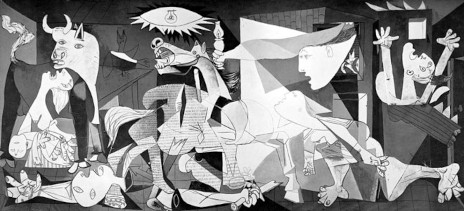
We spent the next day in smaller groups, toodling about the city at seperate paces. By afternoon we'd made it to the Reina Sofia, where we spent a spectacular five plus hours wandering through the single greatest art museum I've ever had the joy of visiting. Standing before Guernica, its massive scale and frozen power causing thousands of mini erruptions in my mind, I was reminded again of the question that plagued my previous writing. In a world so full of wonder, why do we not run in desperate joy to such things each day? If our lives, our full daily efforts, aren't spent in pursuit of the marvelous, what are we doing?
Don't we have an obligation to rejoice in the beauty of the world we've been so blessed to be a part of? Isn't it only this that demonstrates our full appreciation?
I came out of the Reina Sofia glowing, literally struggling to contain my smile, and ran into one of my travel mates. We walked back to the hostel at an ambling pace, he so patient with my crazy and I so full of joy. We met that evening at a scheduled time and calculated a plan for the night, which would end at the airport for our 6 a.m. flight.
What does this mean to five young travellers fresh off the boat from life in a conservative Muslim land?
When we finally tossed our packs back on that night, it was on unstable feet. We made it to the airport, though, and when we finally climbed onto the flight, it was with bated breath.
Next stop, Amsterdam.
"AAAHHHHHHHHHHH!"
Tuesday, March 15, 2011
Chapter Two, Vol. 1: European Crash-tour, Out of Africa
My first full day as an (R)PCV was January 22, 2011. On February 22, I was boarding the ferry to the Cape in Ireland. I look at the calendar, flip through the pages of my little, fat Moleskin planner, and I can see that it was only one month, only four weeks. It was just one 12th of just one year, afterall. In speaking the dates aloud, January 22 does not sound so terribly long ago. "Month" can't do it justice.
Because in my memory some sort of illusion has formed, and I will argue, foot down, fists clenched, that between the 22nd of January and the 22nd of February existed far, far more than just one, single month.
What I mean to say is, it was far, far greater than a month.
Time, you see, cannot accurately be measured on a linear scale, although we spend our lives attempting to do so. If anything, it should be weighed. One extraordinary day, one significant experience, a week of discovery, an hour with someone you love dearly cannot fairly be spoken of with the same vocabulary as one ordinary day, one disappointing experience, a week of routine, an hour in front of the television. They should not be referred to in the same way, and they do not deserve the same size square on my calendar page.
So, what transpired between that morning train out of Rabat and the ferry onto my Emerald Isle, from here on out, will be considered not a month, but the sum of the weight of roughly 30 extraordinary days, of infinite quantities of significant experiences, of four long weeks of discovery, of endless hours with four people I love dearly (and a few guest stars), and so, of one truly grand adventure.
(The next statement is written with the acknowledgment that the following post might as a whole be considered pretentious.) And I don't use this word lightly; I've come to know adventure well.
Actually, this is among the most difficult posts I've written here. Considering the pain and pleasure of my time in Niger, to say so is a self-admittance, a recognition of the level of consequence in this heavy, if short, period of travelling. But I have feared that once I literarily crossed the bridge into the more "developed" world (these quotes pay tribute to the connotation that "development" begs "towards what?") that my travels would no longer be interesting but instead braggart. I guess part of my aforementioned procrastination in writing about this adventure has been due to the worry that you'll be (if I'm honest) threatened, envious or offended by my galivanting.
Galivant [v]: (intr) to go about in search of pleasure; gad about
So many seem to be.
But upon recent discussion with a dear friend (thank heavens for Skype), my worries have been set to rest; perhaps you'd like to hear. Because I've been so blessed to have seen what I have seen, to know who and what I have known, I now have the devoir to share. Else, what good is so much learning?
That said, much of what I have learned in Europe has been about myself, an extraordinary meeting of Djamila and Julia and the little corners of my wonder and imagination that only travel can reveal, and I will try not to bore you too much with these musings. I also learned a lot about my shortcomings (and my crazy), and you have no need to read those either. Of course, such uglier self-discoveries are often the silver lining of misfortune, and our little gang hit a few bumps along the way, particularly before we fell into step together.
Let's begin with the first, um, blunder: our train to Marrakech.
After a foolishly late final night on the roof with Peace Corps folk, we woke the morning of the 22nd in the dark. After (miraculously) meeting in the lobby, dragging all of our belongings to the station and climbing aboard our train with tickets we'd enthusastically purchased in advance, we all promptly passed out cold. And we were off! to Marrakech, our first stop on what was to be a route through Morocco to Spain.
The next thing I remember, I was being jostled awake in the others' shuffle to exit the train, still in the dark. I'd managed approximately the amount of sleep it takes to grow groggier, grumpier and hungrier, but no less fatigued, and my mates didn't appear to be faring much better. We watched through sleep-filled eyes as our connecting train pulled out of the Casablanca station, leaving our dishevelled band to shivver and wait.
Hungover, frustrated, freezing, starving and exhausted, we were still PC volunteers fresh from Niger, well used to waiting for transportation, and thus unfailingly patient. We piled up our luggage, settled onto cold, metal seats and passed the time until the next train fully delighted by cheese sandwiches and tiny paper cups of train station espresso.
As we were telling stories under the Moroccan sunrise, we were approached by a burly guy in a black peacoat.
"Is this where all the Americans hang out?" he asked in an accent that sounded, go figure, just like ours. Steve, a self-labeled refugee from Tunisia -- where he'd been studying Arabic -- would be the first of a string of characters we'd meet on this journey. "After I was tear gased the second time, I figured it was time to leave." He would not, however, prove to be our favorite.
Like many of the people you meet who are living abroad or travelling alone, Steve came off a bit...company hungry? Such is the nature of the lifestye, I guess. He continued to pop in and out of our time in Marrakech, and his Arabic came in handy. He was enthusastic about pending time with us, and he was probably a good guy in the end. (But he remained dedicated to pronouncing Niger as n-eye-jer, despite our correction, in unison, each time he said it.)
Anyway, our first attempt at public transport wasn't smooth. Oh well. We chalked it up to a lesson learned (we didn't miss a single train transfer after this, including one in the early a.m. hours to Tangier) and, when the next train arrived, we heaved our things aboard and climbed in behind.
Only to discover there were no available seats.
So we stacked our bags in the end compartment by the door and squatted, crouched, stood or, in one case, passed out leaning against the luggage, for the next five hours. And you know what? It still wasn't a bush taxi.
It was obvious upon arriving that Marrakech is a nasty tourist trap, Africa meets Disneyland as someone described, and it managed to be the only city on this trip that I significantly disliked. But we enjoyed ourselves anyway.
Inspired by our run-in with Steve, we spent the afternoon inventing a story to tell the new friends we anticipated meeting in hostels, a story about who we were and how we came to be travelling together in Africa and Europe. We plotted the tale over shotglasses of espresso, intermittedly playing "guess their nationality" of the parade of passing tourists. Most suggested backstories from around the table were outlandish, easily disproved or too bizarre to maintain, but eventually we sketched out our script and returned to the hostel ready to greet whoever should come our way. Our first chace presented itself not long after in the form of a Brit, seemingly in his '20s, here on holiday. "Where a' you 'oll comin' from?" he asked.
"Niger," I blurted automatically and cringed ("Dammit Julia!" from the next room). On the bright side, since I blew our cover, we were able to chat freely with this guy. Not far in our conversation it became clear that we didn't need to make up a story for ourselves; ours is crazy enough.
Pens, we told our new friends, are a hot commodity in Niger, eh hem, Neeeger. And someone told a story about kids fist fighting for BIC pens. We laughed, but they looked horrified. Oh, we realized, not normal.
This realiztion would continue to occur throughout our trip, and I thank god that I chose to spend my first month out of Niger with people who could understand. We moved steadily from Africa into progressively bigger, more developed cities throughout the month, easing us semi-gracefully back into the world we'd left. Soon, traffic lights and jarred peanut butter no longer shocked us, but by that time, we were facing baby strollers literally wrapped in plastic and multitudes of girls who seemed to have opted out of wearing pants. From there we faced grocery stores, metros and restaurants where our fellow patrons could hear our English.
I keep thinking about one of my last normal days in the Niamey hostel, perhaps over Christmas. I was just going to run across the road to grab eggs, for breakfast or for baking I don't recall, and so I'd grabbed my change purse and was headed out the concession door. I paused, though, and turned back, unsure if I could go out without my hair covered. I'm just crossing the road, I thought to myself, and I'm in Niamey, so I turned around again. But I hestiated a second time, but my hair's not wrapped. I ran back to the porch, grabbed my scarf and eventually ran my errand, which took approximately 10 minutes.
And now girls aren't wearing pants in public? This month with my fellow volunteers was fantastic not only because of their extraordinary patience, which is invaluable on a trip across Europe over land, but because they allowed me the chance to voice these concerns without self doubt. Had I returned immediately to the States, how on Earth would I have explained how overwhelming it is to see full-sized livestock, to think about the state of your hair, to have regular access to the internet or to drink in out in open public?
And with whom would I have otherwise discussed what happens when your desert feet are suddenly shoved into two pairs of socks and closed toed shoes for extended periods of time? Or how it feels to return to anonymity? Or why in god's name people leave so much good food behind at Medeival fairs?
But most importantly, during that first (somewhat terrifying) month out of country, I did not ever, even once, have to explain, apologize for or justify my feelings for Niger. And that is a precious luxury.
After two nights, we escaped Marrakech on a late morning train to Fes, hopeful that it would prove to be somewhat less scummy. (And it did; should you travel to Morocco, skip Marrakech and head straight for Fes.) The train lasted the whole day, and while this would have seemed a lovely time to write or listen to music or read, none of us did. Instead, we spent the more than eight hours entertained by staring out the large, rain-streaked window at the Moroccan countryside.
It sounds quaint, doesn't it? Taking the train. And that day it was. The weather and view shifted and morphed as we rode along, and midway through the afternoon a woman came past with a little cart and sold us coffees and cheese sandwiches (which we covered in hot sauce). However, the train is not as cute as it seems, and train travel on a budget is more often grating and exhausting than it is darling. We took a lot of trains over the month, and this was the only ride I would describe as pleasant. There is a certain pleasure in mastering the system, though, and in adjusting to a mode of transportation so brilliant and yet so far from American life.
We arrived in Fes after dark without a hostel booked, so we set off from the train station with our packs in tow. Finding a hostel proved simple, thank Allah, because people were eager to help (we were still in Africa). We ended up in a cozy little hostel at the top of the medina back some twisted alley ways that we would not have found without a guide.
Climbing onto a train, even a lovely one, to a destination in which you do not have a place to stay is something of a leap of faith. It isn't difficult to find hostels, of course, particularly travelling in the freezing off season, so there really isn't anything to worry about. Still, it's often difficult to control your worrying, or at least it is for me. (For others, perhaps, it proves more simple; "No stress, no stress," a new friend often says.) As it turns out, worrying is just a waste of time. We really don't have any control either way; if we did, I'd still be in Niger. I suspect that this is a lesson I will have to relearn repeatedly throughout my life, but my experiences in Niger, evacuation in particular, and during this month have tossed me way out in front of the race to a worry-free end. You can call it having faith, as my parents would, or you can call it having patience, as my Nigerien family would, but it is the same: trusting the future to take care of itself.
As supportive proof of this theory, everything in Fes worked itself out perfectly. This hostel too had a little terrace -- the rooftops in Morocco serve the same function as Nigerien concessions, I hear -- and we spent the next couple of days wandering through the grand Fes medina, drinking laughable amounts of coffee and buying the last of our souvenirs before we faced the almighty Euro (once mighty?). In the late afternoon, we had a second friendly guide point us toward a non-touristy hammam, where we literally had the last of Niger scrubbed off of us. The rediscovery of my elbows was a mind-blower. And we passed a fine evening with a couple of our fellow Niger volunteers, who had come before shipping off to new posts in Rwanda. And of course, as we would soon grow accustommed, sometime near midnight we slung on our bags and set off to the train station.
Here's the thing about overnight transportation: there's a fine line between long enough and life-hating misery. Our five hour train, as it turned out, dumped us in Tangier before the sunrise with just enough sleep to turn us to zombies. The day didn't improve much from there, either, so we'll skip ahead to the important part; what do you do on your last night in Africa?
Drink tea, of course.
It wasn't Nigerien tea nor was it particularly good Moroccan tea, plus it was raining. But we sat together, the five of us, and we drank our tea that night, and it redeemed the day. Tea, Niger taught me, often has this power.
We showered that night too, which helps, and repacked all our bags (I had to fit all my tangerines in somewhere!). Early the next morning we hopped into our taxi -- the driver from the day before had agreed to pick us up at the crack of dawn -- and rode once again in the dark to the dock. We were the last people to climb aboard the ferry, the very, very last, but we made it somehow.
And so we left Africa.
As my friends passed out around me on the single most comfortable transportation chairs my butt has ever enjoyed, I sat by the window, headphones in, and watched the sun rise, promising myself I'd make it back someday.
Sunday, March 6, 2011
Give Me Freedom, Give Me Fire
It has come to my attention that it is now March, the greatest of the twelve months. The daffodils are all abloom, and the sun, when it peaks out from behind these chubby clouds, is warm; it's spring.
Most mornings, I take my coffee on a bench just down the lane that overlooks the south harbo(u)r of the island. The sea is surprisngly still and stunningly teal and, as you've surely heard, the grass is impossibly green; I'm in Ireland.
And it was from this mossy bench this morning that I finally began to write the story of my Long Way Home. I've been writing more and more lately. Here and there throughout my fastforwarded days I've paused to make chicken scratched notes. To some degree, the streak of inspriation can be attributed to necessity; I can't even recall my last routine day. For the past two months, I've woken each morning with the jolt that comes from having no recollection of where I am, but also, with a calm acceptance of having equally no idea what will happen today. I can thank Niger for my ability to accept this sort of waking, but this lifestyle does not make a simple tale to tell. To be honest, I've been putting it off. My journaling has been exclusively focused on the here and now. Much better to describe the day's struggles and victories, to remain dedicated to detail. Should I allow myself the liberty to zoom out, to swim among the What It Means, I'd almost surely drown.
I can offer little more, therefore, than the abridged version of this story and continue to beg for your patience as I grapple with this newest version of my life. Take note as well that if the abridged version is this long and wordy, the full-length copy will certainly take years to reveal itself. Actually, many of my stories seem to lie just outside comfortable reaching distance. I can't access them without a bit of a bump from an outside force, and then they fall out of my shelves without my approval. In fact, I've discovered in the past two weeks that it takes approximately three pints before I lose the ability to hold back all my Africa ramblings. (You have been warned.)
It was past midnight last night and I was just sipping through the foam of my third Guiness at Cotter's, the only pub (of two) on the island that is open during the off-season, in front of the coal fireplace with two of my new friends. As is demanded by a pub, we sat shooting the shit, mostly about summers past on the Cape, although the subject quickly came around to times more recent. It had been Marianne's first winter on the island (and her first snow!).
"The fecking quietest New Years I've ever seen," she said, leaning in. Across the table, Pat nodded into his touch-screen phone.
Bump.
It was a trigger I hadn't expected, but the image immediately sent my mind reeling back to Niger, to Abdou's family, to my JICA and to recycled liquor bottles filled with peanuts. These swirlling bouts of miserable confusion stem from the juxtaposition of my current life and that which I've left behind in Niger. When I was there, for example, it seemed completely absurd to think of everything available to a person living in the wealthier world; pineapple in the wintertime does not make any sense. Snacks wrapped individually based on their calorie content do not make any sense. And, for heaven's sake, why did Ben think it was necessary to make rice easier? But just two months later, I was standing in front of the glowing shelves of the cold aisle in SPAR, frustratedly attempting to choose between varieties of sliced cheese. I paid, jammed headphones in, pushed play and stepped into the rain, and it nearly slipped my notice that just weeks ago the sight of cheese, of any type, would have had me thanking Allah.
"How have I gotten here?" I often wonder, as I impatiently click internet links fifteen times or grumble at my co-worker, who has interrupted my painting only to state that kneeling in the grass, as I was already doing, would make my jeans wet, which they already were. "How have I gotten here?"
The literal answer takes us back to just after the quietest fecking New Years I've ever seen. The second week of January we were in Hamdallaye for In-Service Training, happily back among our stage-mates swapping stories of life in our villages and staying up entirely too late. Then one late morning Tondi came to the front of the Refectoire, where we sat waiting for him, with a look on his face I won't soon forget. "You need to have strength," he began, and he read a letter aloud from Washington. We were being evacuated.
It's important to note at this point that I stayed steadily shell-shocked until about midway through my dentist appointment the following week. IST was immediately cancelled, and I returned to my village that evening to say my goodbyes. I gave away most of my things (including Charlie and the Waitress), threw some of what was left into two sacks and was back to the capital less than 24 hours later. We closed our bank accounts that afternoon one-by-excruciating-one, repacked endlessly that night without any idea where we were going or for how long, and were flown out the following morning at some stupid o'clock.
All of the sudden, we were all in Morocco, stubbling filthy and exhausted down plane stairs into a strange green land with air so moist you could taste it. We were shuffled around the next few days as Peace Corps staff trickled in to facilitate the mess, hot hotel showers and Western clothes at the market gradually transforming us into people the other's couldn't immediately recognize. There were all these new people around, too, members of the newest stage that I hadn't yet had a chance to meet. And we were in another world, a city with ATM machines, traffic lights, oranges and black soil. It was jarring, all this different everywhere, and few seemed to be handling it gracefully.
We were sent to counselors. "Have your sleeping or eating habits changed?" Excuse me?!
All that occurred in Rabat now seems a dream. I'd come to an acceptable life decision only for it to be swept up and carried away a moment later, over and over and over again day after day. Near the end of the week we were finally presented with our formal options: slim. Now choose your poison, they said, by tomorrow.
I can recall very little of that snazzy hotel in Rabat other than the unsettling quantity of mirrors everywhere and the sixth floor roof deck.
I'd escaped one evening to said roof where, as it were, I was spitting loogies at the terrifying, gargantuan cats that infest every corner of Morocco, which were down on the street level like round, furry targets, when a couple of the new kids caught me at it. The curious thing about Peace Corps is not that you get to know your fellow volunteers quickly and deeply; sharing such an experience will ultimately do this. The curious thing is that outside of our minute, specific environment, we don't know one another. Faced with tragedy of such scale, we reacted differently and coped at different rates. Or, in my case, didn't cope at all. (:::hack:::splat:::) They told us not to consider applying for a transfer position if we were "stressed." Excuse me?!
Throughout the week I was joined up on that roof by a changing cast, and some of them seemed equally unready to make choices so huge. "What are you doing?" we'd ask one another, perhaps in the hope that someone might actually have a fecking clue. (:::hack:::splat:::) We'd nod as the other answered, and we'd ask the appropriate follow-up questions. Mostly, however, I was just hoping the question wouldn't be turned back at me. But it always was, and eventually, somehow, my answer morphed into an ambiguous "travelling," and some others' did as well.
"Where are you going?"
"Um...Amsterdam." The tickets were cheap, I'd reasoned.
"Hm...I could go to Amsterdam."
And so our five-man group was born, on the roof of a Rabat hotel, mostly out of a shared destination city, and, if you'll forgive my assumption, a decision not to decide quite yet what was next. (:::hack:::splat:::)
I showed up to my appointments, filled out my paperwork, signed on the dotted line. Then one long, weird day, Peace Corps Niger was finished. In what felt like a heartbeat, I'd gone from making plans for my life in Niger to decidedly not doing so for my life after. I had gone from tearfully fighting myself everyday to learn Zarma to fighting myself not to forget it in a world that's never heard of the language. I'd gone from celebrating swearing in to adding that ugly "R" (returned) to the front of my PCV Niger (Peace Corps Volunteer) signature.
And I hated it.
But it stood to my reason at the time that I couldn't quite be a returned PCV if I hadn't returned yet.
And so the next day, the five of us (and a couple of others) took an early train out of Rabat.
Stay tuned for chapter two of my Long Way Home: European Crash-tour.
Friday, January 21, 2011
A Nia-merry Christmas
The following is a backdated post of sorts; while written presently, it addresses past events in a past world. It is intended to be read with an awareness that not only can everything change at a moments notice, it often does. I promise to explain my current situation soon, but for now let's turn back to what was a much more solid reality.
The holidays have come and gone in a cloud of dust. Cold season ushered in green peppers, lettuce, cabbage, vermin, hard amber globs that mysteriously manage to be neither salty, sweet nor particularly pleasant, and a sea of drippy noses, and I woke one shivery morning to discover the air had grown significantly drier than I ever dreamed possible. While temperatures continued to climb into the 90s during the day and evenings dropped no further than perhaps the 60s, I was often bitterly reminded, on the windiest of mornings, of that sweeping landscape in Planet Earth with the snow that evaporates before it can melt because the air is too dry to support a liquid state. No one misses sweating, but this is just a new type of nasty. As the chilly breezes sweep through Kollo, carrying swirling garbage and invisible blankets of dust, my greetings change. "How is the sun?" is replaced by "How is the cold?" It has arrived, everyone agrees, and subsequently forced me into a sleeping bag under my mosquito net (and apparently most of my training class into their houses at night...whimps).
Also, as much as I've grown to love bucket baths, the cold is, well, unfortunately discouraging. Standing on my JICA's (Japanese volunteer) white-tiled floor, in his huge well-lit living room, behind it's tall metal-gated concession, I glanced down at my bare feet, as I often do, to discover they were startingly caked with a level of filth I cannot fully describe but had failed to notice, now in glaring contrast to his own attention to cleanliness. Oh my. To be fair, he has a shower.
And a mirror.
There are few things that describe my existence in Niger more poetically, and emphatically, than the conversations I now believe to be normal, and hold casually.
"All I want for my birthday," a friend recently stated, plopping down into the chair next to mine on the hostel porch, "is to poop."
And it needs not be said aloud that the same friend would not want her zaara, her skirt, if she didn't have its headscarf. "Oh, no, you're right." What good is that?
Two days ago, or something like it, we strolled through the market hunting for inexpensive sneakers to cover our chilly, if dirty, toes. Teems of thin men walked past carrying slices of watermelon or bananas on broad serving trays, balancing stacks of medicine and cigarettes atop their heads, or pushing wheel barrows overflowing with chunky salt, lime green peppers, purple onions. We meandered around and over the piles of little eggplants and oblong tomatoes, past men with stacks of fabrics, through the dank, narrow aisles that reeked of piss. Women in their Niamey-best, each with a baby tied with a zaara to her back, its tiny head bouncing with her steadily swinging strides, chatted or bargained with the men selling shoes and cheap sunglasses and mattresses and used socks. As we exitted the marche, stepping into the blazing sun and blaring taxi horns, we comfortably ignored the shouts of "Anasara!" or "Chinoir;" they were interrupting our thorough discussion of the differences between goat and sheep turds.
After that, perhaps, on some other night, we were in our regular spot in the capital, faces lit in the dark by bouncing neon lights, bare feet in the sand, shouting over the usual Bob Marley and soccer game. Some volunteers were visiting from Benin on their trip around West Africa, and we'd all stopped in for a Beire Niger. We talked about our lives, genuinely interested in the differences, humorously delighted by the similarities, glad for the new faces and perspectives. We righted, I hope, a few rumors (No, Niger volunteers are not issued either a bike or a donkey) and attempted to well-represent our country to these guests, who seemed so like us. We sat together swapping stories long enough that peeing became necessary, but when our new friend returned, she leaned over to her boyfriend and muttered into his ear that there were "little plastic teapots" in these bathrooms too. What were they expecting? Toilet paper?
This environment changes the content of your thoughts. You become so used to Niger that you forget the world before, or that there was once a time when you didn't know, for example, the butta. There was once a time when a half-hour conversation about rainbow pants or methods of sweeping one's yard or the size and blackness of one's boogers were impossibilities in my life. I once didn't expect any random child on the street to do my bidding. I used to think that thngs were "gross;" I used to wash my hair.
In many ways, these changes are coping mechanisms: "What do children in Niger play with?" we were recently asked, sitting in a group.
"Trash?"
"Abandonned shoes."
"Broken glass." ::snort::
"Rocks?"
"Um, batteries mostly."
But I spotted an older child not long ago who had built a kite from the black plastic bags littered everywhere across Niger and a few pieces of millet stalk, and old tires are an infitie source of entertainment. With some sticks, a bit of string and a few old flipflops, children make toys (cutting circles out of the soles for wheels). My (brilliant) little brothers even fashioned functioning headlights on theirs, although I still have no idea how they managed it. Only after the shock wears off, only when you can master it, do these magnificant things begin to appear.
Thus "desensitization" is an ill-fitting title for the process we go through here. I am more sensitive to the beauty, more receptive to the gifts hidden in the muck, than I was when I began. It is a change, but not a toughening one. As we begin to accept Niger for what it is, and accept our role here, as we put roots down and feel the enormous embrace of our communities, we are changed.
The state of Niger is undoubtedly unique in this world, I must admit, as I pass a child squatting in an open stretch of land (and therefore trash) on my morning walk to work. I can see from her posture that she is pooping, but I smile and holler the "N'Goyya" to her "Fofo!" I continue on, stepping out of the path to make way for a passing cow cart. I arrive to the Inspection and am greeted by every person there; they each smile as they offer me water or tea or copto or whatever they have. Because, the longer I am in Niger, the more I see the beauty in that afforementioned "state of Niger." The Sahelien sand has only begun to wear the scales from my eyes.
As many of you have heard, I have recently been ripped from this home that I have created and been forced to abandon the foundation I spent six months building slowly slowly for my next two years. I have many things to say about the process and about Morocco, but for now I'm content to dream back to my world, and the families that I left there. Niger, as a friend recently pointed out, has made us better version of ourselves.
And I am nothing but grateful.

its a great big world


 Posts
Posts