I wish I could say that we burst into Spain, but the truth is they had to prod us a bit to get us off the ferry. When we finally did stumble down the ramp to Algeciras, we found ourselves in another world completely; we'd entered the Christian world.
What does this mean to five young travellers fresh off the boat from life in a conservative Muslim land?
After settling into our hostel, a more difficult task than previously as all but one of us had returned to being deaf to the local language, and a bit of exploration, we landed at our first bar and ordered beer in public. "To Christianity!" we cheered, and approximately three beers later we were skipping through the quaint streets with stones all laid in charming patterns, laughing at ourselves and our rediscovered abandon. Trees in the parks hung heavy with oranges and an open-air market bore the biggest, brightest produce we'd seen yet. And we talked about Niger; and we told stories of our lives before; and we planned for Amsterdam; and we sang along to the campy pop songs that played on the radio. And we started, slowly slowly, to figure one another out.
As delightful as it sounds to travel with your close friends, I discovered on this trip that it can be far more enjoyable to get to know people via adventurous circumstances. As Peace Corps itself demonstrated, sometimes the relationships you build out of necessity, surrounded by unfamiliarity, as your knowledge of yourself is growing, can be the most fruitful. There is some chance, of course, that I happened to travel with four of the most interesting people I've known. But either way, the hours I spent at home squeezed onto the same couches as my close friends can't sustain me in the same way as a single eight hour bus ride through the mountains of Spain. Maybe it inspires a different type of interaction, maybe it builds rapid trust or maybe it's just a hell of a lot of fun, but that first day in Algeciras was the beginning of the rhythm we developed and, I think, we were all grateful for it at some point during the following weeks.
It sounds terrible, but I have to consult my planner to write my way through Spain. It doesn't seem like its been long enough to have forgotten so much, but with days so full, its difficult to recall it all. (Alhamdilalai.)
So, according to this, we spent just one (very early) night in Algeciras before climbing onto a bus to Grenada. Once again, we didn't have a hostel booked, so upon arrival we jumped a city bus toward the Cathedral. We were bobbing along, laden with our heavy bags, when our ears caught two things: First, the American accents of two make-up coated girls seated near us. Next to us, these girls looked clean, rich and, we resasoned, superficial. Study abroad students. Throughout our trip we'd run into more American study abroaders clogging museums and various attractions, and they nearly always proved lewd and alien. During a brief chat with these two we shared very few details of ourselves, content to keep the interaction shallow. But just as my interest had ebated almost completely, we heard the second cue: "AAAHHHHHHHHHH" came the familiar yelling intro to "Waka Waka."
It was starting.
After choosing a bus stop by cursory glance, we trecked down a road full of little shops peddling overpriced Moroccan goods and all things made of hemp, so we figured we were in the right area. Sure enough, we were soon checking into a funny little hostel, up a hill and around the corner from its accompanying bar, run by a Mexican woman who hid money in the books on her kitchen shelves. Once again, we dropped our bags and set to task.
By Spain, it had become decently clear that Peace Corps wasn't going to call us all one morning and yell "PSYCHE!" So, as much as we wanted to run through the streets, some of our settling in time in each new place had to be allotted to the computer. Not one of us had a plan; no one quite knew what was next. In the simplest terms, we'd all been very recently fired and were left to cope with unexpected homelessness and unemployment.
Leaving Niger meant so much more than that, though.
I never quite managed to be afraid of the future, which considering the terror that enraptured me before leaving for Peace Corps, must mean I've come some way since then. In a notebook given generously to me by a travel mate, I wrote a bit on the bus to Grenada before motion sickness stole my effort: "Doing these sorts of things," I wrote, "and thus being this sort of person always seemed fictitious. It was never an impossibility but neither was it particularly likely. I wonder now if it was a matter of confidence, a feeling tht perhaps I could not quite pull it off. I still get that feeling at times, the one that lingers just behind my earlobes and in the new crease between my eyebrows that just keeps my sneakers glued to the floor.
"In the last seven months, however, my shoes gotten less and less sticky. So much so, in fact, that even when terrorists ripped my whole world out from under me, I never quite felt scared..."
I went on to attribute part of this to the people I met while abroad:
"There are people out there who don't think we should live 'fully' or 'carpe diem' or what-the-fuck-ever but rather can't help but to do so. In this way these people don't choose to be 'brave,' 'adventureous' or to become 'experienced,' nor would they ever take credit for the universe's plan to bring them there. Instead, it's an understanding, a simple state of contented being that you are rather than try to be, which tells us that life is neither short nor long, neither hard nor easy, and neither beautiful nor ugly. It is all, and all cannot be labeled in these sorts of ways. But as it is all, as it contains everything already, why wouldn't you roll around in it a bit?
"We can't know anything for sure, so letting fear of the unknown control us quickly gets out of hand. Better to admit your own powerlessness and relax...Give yourself more chances, these people insist...
"We're on the coast of Spain, hour three in the bus, on our way to Grenada. I don't really know what we'll do there, likely something silly or delightfully normal, and there will almost certainly be coffee. And the mountains and the sea and the orange trees and the beauty are refreshing in a way I didn't realize I needed. Niger tore the colors from my eyes; it drained me of my ability to drink up the big and magnificent. It taught me to find beatuy (and inspiration) from other sources, but it also wore out of me a lot of my creative spirit, drained by hardship and furstration and ugliness and poverty and the consistancy of missing so much for so long. It's trickling back to all of us now, mousso mousso, and we're sensitive to it, to the rain, the soil, the trees and the most air, the beer and the freedom, but mostly we notice the beauty in such sweeping measures, hold our breath and hope we don't die from it.
"Because if something so glorious could exist, how could I? with all my weaknesses? If something so gorgeous could lie before me right this instant, is it possible that other equally extraordinary views lie before me always? Are they just farther in the distance? And should I run a bit more quickly to their banks?"
In Spain, I was immersed in this new adventure so fully that Niger, while constantly on our tongues and in our hearts, was often far from my mind. The Big Unknown Future, too, stayed obediently at bay as I focused nearly exclusively on the bigger task at hand, that of living.
As predicted, in Grenada, after a couple of hours of internet surfing, booking ourselves through the next leg of our trip and digging for options to keep us abroad for as long as possible, we did go out. We ate tapas and happily continued our meandering.
Since I called it early while everyone else continued, I woke the next morning hours before the rest. It was grey outside, the trees in every park still in their winter nude, and for a Saturday morning the streets seemed empty. For some reason, it is one of my most vivid memories of Spain. I wandered to the Cathedral, discovering on the way a section of town completely covered in graffiti, bought a newspaper in a language I can no longer read, and settled into a cafe to pass the hours. On my second cup, my notebook came out once again, but this time the weather seems to have soaked into my spirit.
"...We got on the ferry in Africa," I ranted, "rode for no more than two hours, and were spat out upon this gorgeous, wealthy new land. The differences, however, have been frustrating and jarring. Chruch bells for prayer call, drunkenness for modesty, a slow, dreary rain for the blazing desert sun, Spanish with a lisp, spoken by peacoat-sporting men, traded for my bouncy African tongues which spilled from the toothless, smiling mouths of men in long, flourescent jaabas. And for all the glory and beauty of this place, for all of its choices and smells and fruits, impatience radiates here, from these huge old buildings and the people surrounding them. Apathy beats from the footsteps of the crowds marching on the asphalt, pretending not to see me on the streets."
I continued out onto the ledge of an irrational tangent in the following paragraphs that I'll spare you the horror of trying to follow. Instead, lets return to the hostel just after noon, when my travelling friends had resurfaced from beneath their sheets.
By this point, I'd let my grumpiness swallow me whole, and the delayed beginning to our day was grating my nerves. After piddle-farting around the hostel for a while longer, we finally made it out to the road, where we caught the bus up to the Alhambra, the primary attraction of Grenada.
We were freezing, hungry and hungover again, and once again it morphed into a spectacular day. We openned our cheese, meat and bread picnic as we waited our turn to enter the castle, and by the time we'd reached the top tower, we'd broken into the olives, which made for spectacular spitting ammunition. We made our way next into the Matisse exhibit, the brilliance of which lingered through the rest of my day.
The next morning we slung on our packs and headed back to the station to catch another bus to Cordoba, where we'd found a discount hotel room, that's hotel sans the "s," directly across the street from our destination: the Mezquita-Catedral. By the time we arrived and webbed our brains out for a while, we were less interested in the religious site as much as tapas. The sun was bright, so after wandering in and out of restaurants we repeatedly deemed too expensive, we sat ourselves outside an Argentinian grill and ordered the special, the content of which was unknown but for the cervezas.
In comparison to Grenada, there seemed to be people everywhere, piquing our interest. Where are they all going? we wondered. So we followed, as the afternoon flew into evening, and were led to, well, I'm still not completely sure what it was.
Booths lined a couple of streets before spilling into a huge courtyard full of the aroma of roasting meat, sugary candies and beer: a fair. As we were pushed through the hoards of people, past a fucking dragon and signs for warm wine, we began to put the pieces together: a Medieval Fair. What?! How could we be so lucky?! The rest of the evening was packed with hilarity that honestly deserves a blog in itself. At one point, Nichole held a freaking owl. Some octopus was stollen. Costumed people on stilts blew fire. Live music, dancing, free samples, did I mention the dragon?
We did make it to the Mezquita-Catedral the following day, which was lovely but a bit overpriced, where they were selling shotglasses with tiny photos of the mosque on them. Welcome to the Christian world, eh? And later that afternoon we found a record store, where I did not purchase the Graduate soundtrack on vinyl. And I closed the evening on the roof again, with the Spanish stars above and a new, close friend beside.
The next morning we woke before the dawn, determined to catch a city bus to the station for an early bus to Madrid. After an unpleasant search for the correct bus stop, we waited and waited in the dark cold. Just about the time we'd all grown desperate, a truckdriver informed us that our stop was not currently in rotation, and that we'd been standing in vain. So we hitched up our bootstraps and marched our heavy bags all the way across town to the station on foot.
Only to miss our bus by less than ten minutes.
Miserable, exhausted and frozen, we slumped onto metal benches to wait for the next one. It was the first moment I realized my Niger-ingrained patience had begun to ebb, and as we stood at the bar scavenging breakfast, I could see in my friends' faces that I wasn't the only one suffering. Added to my frustrations was a deep disappointment in myself. How could the lessons I learned have faded so rapidly?
How does this world steal so much from us?
"Now I'm thrust back into a world in which I never was content," I had written the day before. "More aware of why I am unhappy here but even more powerless to change it.
"Let me explain. The lessons I've learned in Niger, that I've been blessed with, have given me power via awareness. I can see areas that don't suit my expectations for myself and my world, and that vision is the first imperative to finding my place. HOWEVER, drug prematurely from Niger as we all were has left me with too many frayed edges; my entire life and future are out of control, undefinable and unknowable, and if I cannot grasp the sheets of my life and future, how am I go change them? Whip the wrinkles out? Hang them out to dry when they're damp and musty?"
I drained my orange juice and lingered over my coffee before returning to where the others sat. "Where's Sam?" I wondered allowed.
"At the park."
In the depths of my self-loathing, while an exhageraged, ill-tempered melodrama was streaming through my mind, Sam was bopping along as happy as ever. My self-absorpion shattered by her infitely positive attitude, I headed into the station's candy shop, grinning and grateful again for my new friends.
We caught our bus and arrived in Madrid with its underground metro and walls of skyscrapers. I felt like a farm girl in Manhattan for the first time, my eyes popping as we paraded along the cracked sidewalks in pursuit of our hostel. We found it, finally, and checked in. Dropping our bags for what felt like the thousandth time, a familiar face appeared. Sure enough, two of our fellow Niger volunteers were staying in the same hostel! What luck!
Soon a group of six with a couple of random Americans we'd met in the lobby, we ventured out in Madrid, in newly washed clothes (take note: first time we'd had access to a washing machine). In a Spanish bar along the pub crawl we'd joined, a familiar yell sounded in the room. "AAAAAHHHHHHHHHHHHH!" we answered, rushing back to the dance floor for what was becoming our anthem.
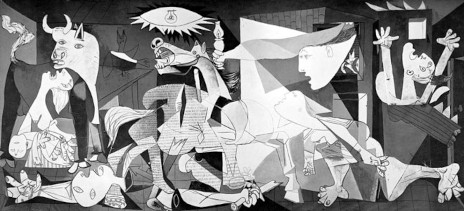
We spent the next day in smaller groups, toodling about the city at seperate paces. By afternoon we'd made it to the Reina Sofia, where we spent a spectacular five plus hours wandering through the single greatest art museum I've ever had the joy of visiting. Standing before Guernica, its massive scale and frozen power causing thousands of mini erruptions in my mind, I was reminded again of the question that plagued my previous writing. In a world so full of wonder, why do we not run in desperate joy to such things each day? If our lives, our full daily efforts, aren't spent in pursuit of the marvelous, what are we doing?
Don't we have an obligation to rejoice in the beauty of the world we've been so blessed to be a part of? Isn't it only this that demonstrates our full appreciation?
I came out of the Reina Sofia glowing, literally struggling to contain my smile, and ran into one of my travel mates. We walked back to the hostel at an ambling pace, he so patient with my crazy and I so full of joy. We met that evening at a scheduled time and calculated a plan for the night, which would end at the airport for our 6 a.m. flight.
What does this mean to five young travellers fresh off the boat from life in a conservative Muslim land?
When we finally tossed our packs back on that night, it was on unstable feet. We made it to the airport, though, and when we finally climbed onto the flight, it was with bated breath.
Next stop, Amsterdam.
"AAAHHHHHHHHHHH!"
Wednesday, March 30, 2011
Vol. 2: Como esta la casa de gato?

Tuesday, March 15, 2011
Chapter Two, Vol. 1: European Crash-tour, Out of Africa
My first full day as an (R)PCV was January 22, 2011. On February 22, I was boarding the ferry to the Cape in Ireland. I look at the calendar, flip through the pages of my little, fat Moleskin planner, and I can see that it was only one month, only four weeks. It was just one 12th of just one year, afterall. In speaking the dates aloud, January 22 does not sound so terribly long ago. "Month" can't do it justice.
Because in my memory some sort of illusion has formed, and I will argue, foot down, fists clenched, that between the 22nd of January and the 22nd of February existed far, far more than just one, single month.
What I mean to say is, it was far, far greater than a month.
Time, you see, cannot accurately be measured on a linear scale, although we spend our lives attempting to do so. If anything, it should be weighed. One extraordinary day, one significant experience, a week of discovery, an hour with someone you love dearly cannot fairly be spoken of with the same vocabulary as one ordinary day, one disappointing experience, a week of routine, an hour in front of the television. They should not be referred to in the same way, and they do not deserve the same size square on my calendar page.
So, what transpired between that morning train out of Rabat and the ferry onto my Emerald Isle, from here on out, will be considered not a month, but the sum of the weight of roughly 30 extraordinary days, of infinite quantities of significant experiences, of four long weeks of discovery, of endless hours with four people I love dearly (and a few guest stars), and so, of one truly grand adventure.
(The next statement is written with the acknowledgment that the following post might as a whole be considered pretentious.) And I don't use this word lightly; I've come to know adventure well.
Actually, this is among the most difficult posts I've written here. Considering the pain and pleasure of my time in Niger, to say so is a self-admittance, a recognition of the level of consequence in this heavy, if short, period of travelling. But I have feared that once I literarily crossed the bridge into the more "developed" world (these quotes pay tribute to the connotation that "development" begs "towards what?") that my travels would no longer be interesting but instead braggart. I guess part of my aforementioned procrastination in writing about this adventure has been due to the worry that you'll be (if I'm honest) threatened, envious or offended by my galivanting.
Galivant [v]: (intr) to go about in search of pleasure; gad about
So many seem to be.
But upon recent discussion with a dear friend (thank heavens for Skype), my worries have been set to rest; perhaps you'd like to hear. Because I've been so blessed to have seen what I have seen, to know who and what I have known, I now have the devoir to share. Else, what good is so much learning?
That said, much of what I have learned in Europe has been about myself, an extraordinary meeting of Djamila and Julia and the little corners of my wonder and imagination that only travel can reveal, and I will try not to bore you too much with these musings. I also learned a lot about my shortcomings (and my crazy), and you have no need to read those either. Of course, such uglier self-discoveries are often the silver lining of misfortune, and our little gang hit a few bumps along the way, particularly before we fell into step together.
Let's begin with the first, um, blunder: our train to Marrakech.
After a foolishly late final night on the roof with Peace Corps folk, we woke the morning of the 22nd in the dark. After (miraculously) meeting in the lobby, dragging all of our belongings to the station and climbing aboard our train with tickets we'd enthusastically purchased in advance, we all promptly passed out cold. And we were off! to Marrakech, our first stop on what was to be a route through Morocco to Spain.
The next thing I remember, I was being jostled awake in the others' shuffle to exit the train, still in the dark. I'd managed approximately the amount of sleep it takes to grow groggier, grumpier and hungrier, but no less fatigued, and my mates didn't appear to be faring much better. We watched through sleep-filled eyes as our connecting train pulled out of the Casablanca station, leaving our dishevelled band to shivver and wait.
Hungover, frustrated, freezing, starving and exhausted, we were still PC volunteers fresh from Niger, well used to waiting for transportation, and thus unfailingly patient. We piled up our luggage, settled onto cold, metal seats and passed the time until the next train fully delighted by cheese sandwiches and tiny paper cups of train station espresso.
As we were telling stories under the Moroccan sunrise, we were approached by a burly guy in a black peacoat.
"Is this where all the Americans hang out?" he asked in an accent that sounded, go figure, just like ours. Steve, a self-labeled refugee from Tunisia -- where he'd been studying Arabic -- would be the first of a string of characters we'd meet on this journey. "After I was tear gased the second time, I figured it was time to leave." He would not, however, prove to be our favorite.
Like many of the people you meet who are living abroad or travelling alone, Steve came off a bit...company hungry? Such is the nature of the lifestye, I guess. He continued to pop in and out of our time in Marrakech, and his Arabic came in handy. He was enthusastic about pending time with us, and he was probably a good guy in the end. (But he remained dedicated to pronouncing Niger as n-eye-jer, despite our correction, in unison, each time he said it.)
Anyway, our first attempt at public transport wasn't smooth. Oh well. We chalked it up to a lesson learned (we didn't miss a single train transfer after this, including one in the early a.m. hours to Tangier) and, when the next train arrived, we heaved our things aboard and climbed in behind.
Only to discover there were no available seats.
So we stacked our bags in the end compartment by the door and squatted, crouched, stood or, in one case, passed out leaning against the luggage, for the next five hours. And you know what? It still wasn't a bush taxi.
It was obvious upon arriving that Marrakech is a nasty tourist trap, Africa meets Disneyland as someone described, and it managed to be the only city on this trip that I significantly disliked. But we enjoyed ourselves anyway.
Inspired by our run-in with Steve, we spent the afternoon inventing a story to tell the new friends we anticipated meeting in hostels, a story about who we were and how we came to be travelling together in Africa and Europe. We plotted the tale over shotglasses of espresso, intermittedly playing "guess their nationality" of the parade of passing tourists. Most suggested backstories from around the table were outlandish, easily disproved or too bizarre to maintain, but eventually we sketched out our script and returned to the hostel ready to greet whoever should come our way. Our first chace presented itself not long after in the form of a Brit, seemingly in his '20s, here on holiday. "Where a' you 'oll comin' from?" he asked.
"Niger," I blurted automatically and cringed ("Dammit Julia!" from the next room). On the bright side, since I blew our cover, we were able to chat freely with this guy. Not far in our conversation it became clear that we didn't need to make up a story for ourselves; ours is crazy enough.
Pens, we told our new friends, are a hot commodity in Niger, eh hem, Neeeger. And someone told a story about kids fist fighting for BIC pens. We laughed, but they looked horrified. Oh, we realized, not normal.
This realiztion would continue to occur throughout our trip, and I thank god that I chose to spend my first month out of Niger with people who could understand. We moved steadily from Africa into progressively bigger, more developed cities throughout the month, easing us semi-gracefully back into the world we'd left. Soon, traffic lights and jarred peanut butter no longer shocked us, but by that time, we were facing baby strollers literally wrapped in plastic and multitudes of girls who seemed to have opted out of wearing pants. From there we faced grocery stores, metros and restaurants where our fellow patrons could hear our English.
I keep thinking about one of my last normal days in the Niamey hostel, perhaps over Christmas. I was just going to run across the road to grab eggs, for breakfast or for baking I don't recall, and so I'd grabbed my change purse and was headed out the concession door. I paused, though, and turned back, unsure if I could go out without my hair covered. I'm just crossing the road, I thought to myself, and I'm in Niamey, so I turned around again. But I hestiated a second time, but my hair's not wrapped. I ran back to the porch, grabbed my scarf and eventually ran my errand, which took approximately 10 minutes.
And now girls aren't wearing pants in public? This month with my fellow volunteers was fantastic not only because of their extraordinary patience, which is invaluable on a trip across Europe over land, but because they allowed me the chance to voice these concerns without self doubt. Had I returned immediately to the States, how on Earth would I have explained how overwhelming it is to see full-sized livestock, to think about the state of your hair, to have regular access to the internet or to drink in out in open public?
And with whom would I have otherwise discussed what happens when your desert feet are suddenly shoved into two pairs of socks and closed toed shoes for extended periods of time? Or how it feels to return to anonymity? Or why in god's name people leave so much good food behind at Medeival fairs?
But most importantly, during that first (somewhat terrifying) month out of country, I did not ever, even once, have to explain, apologize for or justify my feelings for Niger. And that is a precious luxury.
After two nights, we escaped Marrakech on a late morning train to Fes, hopeful that it would prove to be somewhat less scummy. (And it did; should you travel to Morocco, skip Marrakech and head straight for Fes.) The train lasted the whole day, and while this would have seemed a lovely time to write or listen to music or read, none of us did. Instead, we spent the more than eight hours entertained by staring out the large, rain-streaked window at the Moroccan countryside.
It sounds quaint, doesn't it? Taking the train. And that day it was. The weather and view shifted and morphed as we rode along, and midway through the afternoon a woman came past with a little cart and sold us coffees and cheese sandwiches (which we covered in hot sauce). However, the train is not as cute as it seems, and train travel on a budget is more often grating and exhausting than it is darling. We took a lot of trains over the month, and this was the only ride I would describe as pleasant. There is a certain pleasure in mastering the system, though, and in adjusting to a mode of transportation so brilliant and yet so far from American life.
We arrived in Fes after dark without a hostel booked, so we set off from the train station with our packs in tow. Finding a hostel proved simple, thank Allah, because people were eager to help (we were still in Africa). We ended up in a cozy little hostel at the top of the medina back some twisted alley ways that we would not have found without a guide.
Climbing onto a train, even a lovely one, to a destination in which you do not have a place to stay is something of a leap of faith. It isn't difficult to find hostels, of course, particularly travelling in the freezing off season, so there really isn't anything to worry about. Still, it's often difficult to control your worrying, or at least it is for me. (For others, perhaps, it proves more simple; "No stress, no stress," a new friend often says.) As it turns out, worrying is just a waste of time. We really don't have any control either way; if we did, I'd still be in Niger. I suspect that this is a lesson I will have to relearn repeatedly throughout my life, but my experiences in Niger, evacuation in particular, and during this month have tossed me way out in front of the race to a worry-free end. You can call it having faith, as my parents would, or you can call it having patience, as my Nigerien family would, but it is the same: trusting the future to take care of itself.
As supportive proof of this theory, everything in Fes worked itself out perfectly. This hostel too had a little terrace -- the rooftops in Morocco serve the same function as Nigerien concessions, I hear -- and we spent the next couple of days wandering through the grand Fes medina, drinking laughable amounts of coffee and buying the last of our souvenirs before we faced the almighty Euro (once mighty?). In the late afternoon, we had a second friendly guide point us toward a non-touristy hammam, where we literally had the last of Niger scrubbed off of us. The rediscovery of my elbows was a mind-blower. And we passed a fine evening with a couple of our fellow Niger volunteers, who had come before shipping off to new posts in Rwanda. And of course, as we would soon grow accustommed, sometime near midnight we slung on our bags and set off to the train station.
Here's the thing about overnight transportation: there's a fine line between long enough and life-hating misery. Our five hour train, as it turned out, dumped us in Tangier before the sunrise with just enough sleep to turn us to zombies. The day didn't improve much from there, either, so we'll skip ahead to the important part; what do you do on your last night in Africa?
Drink tea, of course.
It wasn't Nigerien tea nor was it particularly good Moroccan tea, plus it was raining. But we sat together, the five of us, and we drank our tea that night, and it redeemed the day. Tea, Niger taught me, often has this power.
We showered that night too, which helps, and repacked all our bags (I had to fit all my tangerines in somewhere!). Early the next morning we hopped into our taxi -- the driver from the day before had agreed to pick us up at the crack of dawn -- and rode once again in the dark to the dock. We were the last people to climb aboard the ferry, the very, very last, but we made it somehow.
And so we left Africa.
As my friends passed out around me on the single most comfortable transportation chairs my butt has ever enjoyed, I sat by the window, headphones in, and watched the sun rise, promising myself I'd make it back someday.
Sunday, March 6, 2011
Give Me Freedom, Give Me Fire
It has come to my attention that it is now March, the greatest of the twelve months. The daffodils are all abloom, and the sun, when it peaks out from behind these chubby clouds, is warm; it's spring.
Most mornings, I take my coffee on a bench just down the lane that overlooks the south harbo(u)r of the island. The sea is surprisngly still and stunningly teal and, as you've surely heard, the grass is impossibly green; I'm in Ireland.
And it was from this mossy bench this morning that I finally began to write the story of my Long Way Home. I've been writing more and more lately. Here and there throughout my fastforwarded days I've paused to make chicken scratched notes. To some degree, the streak of inspriation can be attributed to necessity; I can't even recall my last routine day. For the past two months, I've woken each morning with the jolt that comes from having no recollection of where I am, but also, with a calm acceptance of having equally no idea what will happen today. I can thank Niger for my ability to accept this sort of waking, but this lifestyle does not make a simple tale to tell. To be honest, I've been putting it off. My journaling has been exclusively focused on the here and now. Much better to describe the day's struggles and victories, to remain dedicated to detail. Should I allow myself the liberty to zoom out, to swim among the What It Means, I'd almost surely drown.
I can offer little more, therefore, than the abridged version of this story and continue to beg for your patience as I grapple with this newest version of my life. Take note as well that if the abridged version is this long and wordy, the full-length copy will certainly take years to reveal itself. Actually, many of my stories seem to lie just outside comfortable reaching distance. I can't access them without a bit of a bump from an outside force, and then they fall out of my shelves without my approval. In fact, I've discovered in the past two weeks that it takes approximately three pints before I lose the ability to hold back all my Africa ramblings. (You have been warned.)
It was past midnight last night and I was just sipping through the foam of my third Guiness at Cotter's, the only pub (of two) on the island that is open during the off-season, in front of the coal fireplace with two of my new friends. As is demanded by a pub, we sat shooting the shit, mostly about summers past on the Cape, although the subject quickly came around to times more recent. It had been Marianne's first winter on the island (and her first snow!).
"The fecking quietest New Years I've ever seen," she said, leaning in. Across the table, Pat nodded into his touch-screen phone.
Bump.
It was a trigger I hadn't expected, but the image immediately sent my mind reeling back to Niger, to Abdou's family, to my JICA and to recycled liquor bottles filled with peanuts. These swirlling bouts of miserable confusion stem from the juxtaposition of my current life and that which I've left behind in Niger. When I was there, for example, it seemed completely absurd to think of everything available to a person living in the wealthier world; pineapple in the wintertime does not make any sense. Snacks wrapped individually based on their calorie content do not make any sense. And, for heaven's sake, why did Ben think it was necessary to make rice easier? But just two months later, I was standing in front of the glowing shelves of the cold aisle in SPAR, frustratedly attempting to choose between varieties of sliced cheese. I paid, jammed headphones in, pushed play and stepped into the rain, and it nearly slipped my notice that just weeks ago the sight of cheese, of any type, would have had me thanking Allah.
"How have I gotten here?" I often wonder, as I impatiently click internet links fifteen times or grumble at my co-worker, who has interrupted my painting only to state that kneeling in the grass, as I was already doing, would make my jeans wet, which they already were. "How have I gotten here?"
The literal answer takes us back to just after the quietest fecking New Years I've ever seen. The second week of January we were in Hamdallaye for In-Service Training, happily back among our stage-mates swapping stories of life in our villages and staying up entirely too late. Then one late morning Tondi came to the front of the Refectoire, where we sat waiting for him, with a look on his face I won't soon forget. "You need to have strength," he began, and he read a letter aloud from Washington. We were being evacuated.
It's important to note at this point that I stayed steadily shell-shocked until about midway through my dentist appointment the following week. IST was immediately cancelled, and I returned to my village that evening to say my goodbyes. I gave away most of my things (including Charlie and the Waitress), threw some of what was left into two sacks and was back to the capital less than 24 hours later. We closed our bank accounts that afternoon one-by-excruciating-one, repacked endlessly that night without any idea where we were going or for how long, and were flown out the following morning at some stupid o'clock.
All of the sudden, we were all in Morocco, stubbling filthy and exhausted down plane stairs into a strange green land with air so moist you could taste it. We were shuffled around the next few days as Peace Corps staff trickled in to facilitate the mess, hot hotel showers and Western clothes at the market gradually transforming us into people the other's couldn't immediately recognize. There were all these new people around, too, members of the newest stage that I hadn't yet had a chance to meet. And we were in another world, a city with ATM machines, traffic lights, oranges and black soil. It was jarring, all this different everywhere, and few seemed to be handling it gracefully.
We were sent to counselors. "Have your sleeping or eating habits changed?" Excuse me?!
All that occurred in Rabat now seems a dream. I'd come to an acceptable life decision only for it to be swept up and carried away a moment later, over and over and over again day after day. Near the end of the week we were finally presented with our formal options: slim. Now choose your poison, they said, by tomorrow.
I can recall very little of that snazzy hotel in Rabat other than the unsettling quantity of mirrors everywhere and the sixth floor roof deck.
I'd escaped one evening to said roof where, as it were, I was spitting loogies at the terrifying, gargantuan cats that infest every corner of Morocco, which were down on the street level like round, furry targets, when a couple of the new kids caught me at it. The curious thing about Peace Corps is not that you get to know your fellow volunteers quickly and deeply; sharing such an experience will ultimately do this. The curious thing is that outside of our minute, specific environment, we don't know one another. Faced with tragedy of such scale, we reacted differently and coped at different rates. Or, in my case, didn't cope at all. (:::hack:::splat:::) They told us not to consider applying for a transfer position if we were "stressed." Excuse me?!
Throughout the week I was joined up on that roof by a changing cast, and some of them seemed equally unready to make choices so huge. "What are you doing?" we'd ask one another, perhaps in the hope that someone might actually have a fecking clue. (:::hack:::splat:::) We'd nod as the other answered, and we'd ask the appropriate follow-up questions. Mostly, however, I was just hoping the question wouldn't be turned back at me. But it always was, and eventually, somehow, my answer morphed into an ambiguous "travelling," and some others' did as well.
"Where are you going?"
"Um...Amsterdam." The tickets were cheap, I'd reasoned.
"Hm...I could go to Amsterdam."
And so our five-man group was born, on the roof of a Rabat hotel, mostly out of a shared destination city, and, if you'll forgive my assumption, a decision not to decide quite yet what was next. (:::hack:::splat:::)
I showed up to my appointments, filled out my paperwork, signed on the dotted line. Then one long, weird day, Peace Corps Niger was finished. In what felt like a heartbeat, I'd gone from making plans for my life in Niger to decidedly not doing so for my life after. I had gone from tearfully fighting myself everyday to learn Zarma to fighting myself not to forget it in a world that's never heard of the language. I'd gone from celebrating swearing in to adding that ugly "R" (returned) to the front of my PCV Niger (Peace Corps Volunteer) signature.
And I hated it.
But it stood to my reason at the time that I couldn't quite be a returned PCV if I hadn't returned yet.
And so the next day, the five of us (and a couple of others) took an early train out of Rabat.
Stay tuned for chapter two of my Long Way Home: European Crash-tour.

its a great big world


 Posts
Posts